
 Your Guide to Space
Routine
TJSW-25
A station-pathfinder mission that could turn commercial low-Earth-orbit plans into tested hardware.
This appears important for tracking China’s ongoing heavy-lift and national security launch cadence, but the supplied sources do not indicate that TJSW-25 by itself is a flagship or roadmap-defining mission.
Source record
Your local time
China Aerospace Science and Technology Corporation
Wenchang Space Launch Site, People's Republic of China
Program-critical
Thirty-second brief
What is launching, why it matters, and what to watch.
A station-pathfinder mission that could turn commercial low-Earth-orbit plans into tested hardware.
A successful Long March 5 flight adds another confirmed data point for CASC’s heavy-lift operations to geostationary transfer orbit, even though the mission cargo’s exact role is not publicly clear.
Whether Additional Official Or Semi-official Reporting Clarifies The Spacecraft’s Mission Beyond Communication Technology Testing: Whether Additional Official Or Semi-official Reporting Clarifies The Spacecraft’s Mission Beyond Communication Technology Testing is one of the observable moments that can change how this mission should be interpreted. Any Follow-up Confirmation Of Orbital Insertion Details Or Spacecraft Deployment Timing: mission cargo separation is the first sign that the spacecraft part of the mission can begin. How This Launch Factors Into The Observed Long March 5 Flight Cadence And Reliability Trend: How This Launch Factors Into The Observed Long March 5 Flight Cadence And Reliability Trend is one of the observable moments that can change how this mission should be interpreted.
Program-critical
Understand the mission behind the countdown.
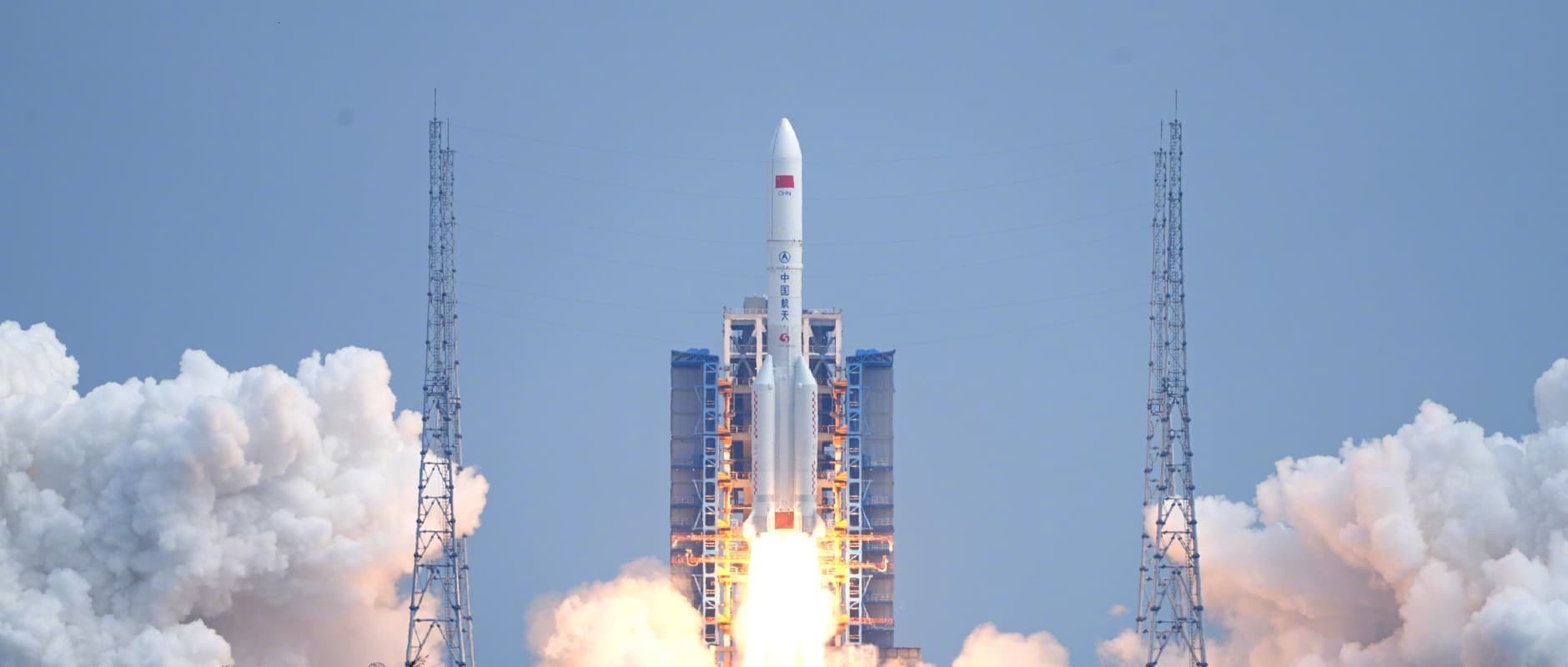
The immediate objective: CASC’s Long March 5 launched TJSW-25 from pad 101 at Wenchang on 2026-06-11, with launch status listed as successful. Public details remain limited because the mission is categorized as Government/Top Secret; The Space Devs describes it as a Chinese classified satellite claimed to be for communication technology test purposes, with the actual mission not known.
The bigger story: Commercial space stations.
What is genuinely new: The delta is whether a station plan produces testable hardware, contracts, interfaces, and launch commitments rather than renderings.
Why a non-expert might care: Direct for future low-Earth-orbit work: commercial stations decide where crewed research and private missions go after ISS.
Boundaries
What success would not prove.
Launch success would not automatically prove mission cargo commissioning or final mission success.
Watch points
Moments that change the read.
Use the official watch link near the target time, and expect holds if the provider, range, or weather teams pause the count.
- Whether Additional Official Or Semi-official Reporting Clarifies The Spacecraft’s Mission Beyond Communication Technology Testing: Whether Additional Official Or Semi-official Reporting Clarifies The Spacecraft’s Mission Beyond Communication Technology Testing is one of the observable moments that can change how this mission should be interpreted.
- Any Follow-up Confirmation Of Orbital Insertion Details Or Spacecraft Deployment Timing: mission cargo separation is the first sign that the spacecraft part of the mission can begin.
- How This Launch Factors Into The Observed Long March 5 Flight Cadence And Reliability Trend: How This Launch Factors Into The Observed Long March 5 Flight Cadence And Reliability Trend is one of the observable moments that can change how this mission should be interpreted.
Where it fits
Past evidence, this mission, next follow-up.
This launch: A station-pathfinder mission that could turn commercial low-Earth-orbit plans into tested hardware.
Next required milestone: Hardware launch, crew interface testing, safety review, and customer operations.
Commercial space stations
Commercial Space Stations: A guide to why post-ISS stations are being built, who is building them, who might pay, and what has to work before they become real infrastructure.
How to watch a rocket launch
How to Watch a Rocket Launch: A viewer guide for livestreams, countdown clocks, holds, weather rules, booster landings, mission audio, and reliable sources.
Confirmed
Confirmed, interpreted, and still unknown.
Confirmed: TJSW-25 is listed with China Aerospace Science and Technology Corporation as provider. Long March 5 is the listed vehicle. 101 is the listed launch site. Geostationary Transfer Orbit is the listed destination or orbit class.
Starman Nova interpretation: A successful Long March 5 flight adds another confirmed data point for CASC’s heavy-lift operations to geostationary transfer orbit, even though the mission cargo’s exact role is not publicly clear. The delta is whether a station plan produces testable hardware, contracts, interfaces, and launch commitments rather than renderings.
Still unknown: Postflight findings, commissioning details, and later mission outcome still need official confirmation.
Deployment completed; operational result pending
Post-launch verdict.
TJSW-25 has moved out of pre-launch watch and into outcome follow-up.
The launch layer can be separated from deployment, spacecraft health, commissioning, and mission success.
Still pending: Deployment confirmation, First contact, Commissioning, Final service or science result.
Reminder options
Track this launch
Save interest in this launch and join the briefing list for well-sourced schedule changes, webcast availability, and post-launch results.
Launch reminder
Save this specific launch so future schedule and status changes can be matched to your interest.
Recent coverage
Latest updates
Long March 5 successfully launches classified TJSW-25 satellite: CASC launched TJSW-25 aboard a Long March 5 from Pad 101 at Wenchang on June 11, 2026. The launch was reported successful, with the classified mission cargo inserted into geostationary transfer orbit.
Long March 5 successfully launched the classified TJSW-25 mission to GTO from Wenchang: CASC’s Long March 5 launched TJSW-25 from pad 101 at Wenchang on 2026-06-11, with launch status listed as successful. Public details remain limited because the mission is categorized as Government/Top Secret; The Space Devs describes it as a Chinese classified satellite claimed to be for communication technology test purposes, with the actual mission not known.
Published 2026-07-24.
Published 2026-06-29.
Next steps
Keep the roadmap in view
Get major space updates, set launch reminder interest, or keep exploring the Roadmap that turns space progress into a readable system.