
 Your Guide to Space
Guide
Space terms should point you to the right story.
Use the glossary when a launch stream, Artemis update, commercial station plan, debris headline, market report, or science result starts speaking in shorthand. The goal is not to memorize jargon. It is to know what question to ask next.
Find the situation first, read the plain-English meaning, then follow the related guide or tracker. The definition earns its place only if the next update becomes easier to judge.
Reader paths
Start with the situation, then use the term.
Most space words only matter because they change how a launch, mission, market, regulation, or science result should be read.
Countdown, holds, staging, deployment, and confirmation.
Following a failureAnomaly, mishap, corrective action, and return to flight.
Reading ArtemisCislunar, Gateway, landers, CLPS, surface systems, and samples.
Judging marketsCustomers, procurement, services, utilization, and demand.
Reader tool
Definitions work best when they send you somewhere useful.
Start with the situation you are reading about: a live launch, an orbit, a recovery attempt, a lunar program, a station market, a science result, or a regulatory decision.
Each term is short on purpose. The definition should unlock the nearby story, then the links should take you to the deeper guide or tracker where the concept actually matters.
Term groups
The same word can matter differently in each story.
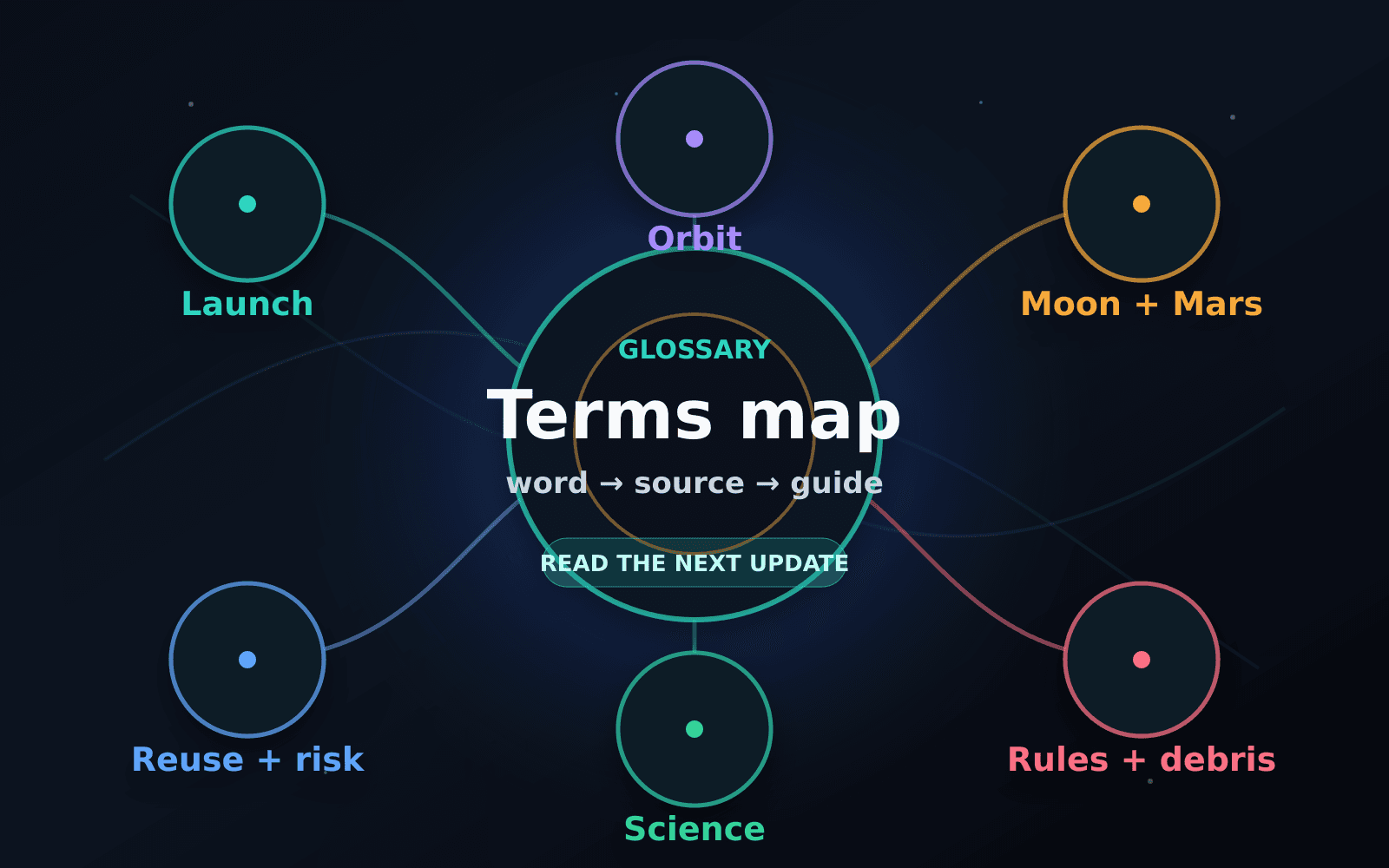
The grouping keeps launch mechanics, orbital destinations, reuse, Moon-to-Mars systems, commercial markets, science evidence, and regulation from collapsing into one long alphabetized dump.
Launch and Ascent
9 termsUse these while watching a webcast, reading the launch dashboard, or trying to understand why the countdown changed.
Countdown time before the planned liftoff. Holds can pause the clock without ending the attempt.
Where it matters: How rocket launches work / How to watch a launchA planned or unplanned pause while teams resolve a countdown issue.
Where it matters: How rocket launches work / How to watch a launchA launch attempt stopped before liftoff, usually because weather, range, vehicle, or payload limits were not acceptable.
Where it matters: How rocket launches work / How to watch a launchThe point of highest aerodynamic pressure during ascent, when the vehicle is pushing hardest against the atmosphere.
Where it matters: How rocket launches work / How to watch a launchThe planned shutdown of a booster or core stage before staging or separation.
Where it matters: How rocket launches work / How to watch a launchThe handoff when one rocket stage separates so the next stage can continue the mission.
Where it matters: How rocket launches work / How to watch a launchThe protective shell around a payload during atmospheric ascent.
Where it matters: How rocket launches work / How to watch a launchThe later rocket stage that completes orbit insertion, deployment, or a higher-energy trajectory after the booster is done.
Where it matters: How rocket launches work / How to watch a launchThe burn or sequence that places a spacecraft into its intended orbit or trajectory.
Where it matters: How rocket launches work / How to watch a launchOrbits and Destinations
8 termsThese explain where the payload is going and why some missions need more energy, time, or maneuvering than others.
The region close enough to Earth for many satellites, crew vehicles, and commercial station plans.
Where it matters: Launch dashboard / Space progress calendarA high orbit where a satellite appears fixed over one longitude on Earth.
Where it matters: Launch dashboard / Space progress calendarA near-polar orbit that keeps similar local lighting conditions over each ground pass, useful for Earth observation.
Where it matters: Launch dashboard / Space progress calendarAn elliptical transfer path often used before a spacecraft raises itself toward geostationary orbit.
Where it matters: Launch dashboard / Space progress calendarThe highest and lowest points in an elliptical orbit.
Where it matters: Launch dashboard / Space progress calendarThe change in velocity a spacecraft needs for a maneuver, transfer, rendezvous, or landing.
Where it matters: Launch dashboard / Space progress calendarA burn that sends a spacecraft from Earth orbit toward the Moon.
Where it matters: Launch dashboard / Space progress calendarMatching orbit and approach with another spacecraft, then making a controlled connection.
Where it matters: Launch dashboard / Space progress calendarReuse, Failures, and Safety
9 termsThese keep recovery, reflight, test failures, investigations, and public-safety language separate.
Flying hardware again after recovery, inspection, refurbishment, and customer acceptance.
Where it matters: Reusable rockets / Why rockets fail / Anomaly trackerReuse with short, repeatable turnaround rather than a one-off recovery followed by long refurbishment.
Where it matters: Reusable rockets / Why rockets fail / Anomaly trackerA booster landing on a drone ship or platform away from the launch site.
Where it matters: Reusable rockets / Why rockets fail / Anomaly trackerA booster returns near the launch site after stage separation instead of landing downrange.
Where it matters: Reusable rockets / Why rockets fail / Anomaly trackerA burn that helps a returning booster manage heating and speed before the final landing sequence.
Where it matters: Reusable rockets / Why rockets fail / Anomaly trackerThe final engine burn that slows a booster or vehicle for touchdown, catch, or controlled impact.
Where it matters: Reusable rockets / Why rockets fail / Anomaly trackerAn unexpected event during testing, launch, flight, deployment, landing, or operations that needs well-sourced explanation.
Where it matters: Reusable rockets / Why rockets fail / Anomaly trackerA formal process after a safety-significant commercial launch or reentry event, often under regulator oversight.
Where it matters: Reusable rockets / Why rockets fail / Anomaly trackerThe point when a vehicle or operation is allowed to resume after required investigation, fixes, licensing, or safety work.
Where it matters: Reusable rockets / Why rockets fail / Anomaly trackerMoon, Mars, and Surface Systems
8 termsThese decode Artemis, lunar infrastructure, robotic precursor work, and Mars-settlement claims.
NASA's Moon-to-Mars campaign, combining SLS, Orion, landers, Gateway, spacesuits, surface systems, science, and partners.
Where it matters: Artemis explained / Lunar infrastructure / Moon-to-MarsThe region between Earth and the Moon, including lunar orbit and staging paths.
Where it matters: Artemis explained / Lunar infrastructure / Moon-to-MarsNASA's planned lunar-orbit outpost for staging, logistics, power, habitation, science, and Artemis operations.
Where it matters: Artemis explained / Lunar infrastructure / Moon-to-MarsThe Artemis commercial lander lane intended to move astronauts between Orion, Gateway, or other staging paths and the lunar surface.
Where it matters: Artemis explained / Lunar infrastructure / Moon-to-MarsNASA's commercial lunar delivery program for robotic science and technology payloads.
Where it matters: Artemis explained / Lunar infrastructure / Moon-to-MarsUsing local materials such as lunar or Martian resources instead of bringing everything from Earth.
Where it matters: Artemis explained / Lunar infrastructure / Moon-to-MarsThe loose dust and broken rock covering the Moon, Mars, and other airless or thin-atmosphere bodies.
Where it matters: Artemis explained / Lunar infrastructure / Moon-to-MarsA mission that brings material from another world back to Earth for laboratory study.
Where it matters: Artemis explained / Lunar infrastructure / Moon-to-MarsStations and Space Economy
8 termsThese help distinguish real services and customers from station renderings, market-size headlines, and broad industry claims.
A private or commercial low Earth orbit station intended to succeed some ISS services after the transition.
Where it matters: Commercial stations / Space economyA customer, often a government agency, whose demand helps make a new space service financially credible.
Where it matters: Commercial stations / Space economyTransportation, training, operations, and safety support for people traveling to and from orbit.
Where it matters: Commercial stations / Space economyThe delivery and return of supplies, experiments, hardware, or samples for an orbital customer.
Where it matters: Commercial stations / Space economyResearch that uses orbit's near-weightless environment for biology, materials, fluids, medicine, or manufacturing tests.
Where it matters: Commercial stations / Space economyHow much a station, spacecraft, or service is actually used by customers, researchers, agencies, or operators.
Where it matters: Commercial stations / Space economyInspecting, repairing, refueling, upgrading, assembling, or moving spacecraft after launch.
Where it matters: Commercial stations / Space economyA public contracting step such as a solicitation, award, design review, certification, or service task order.
Where it matters: Commercial stations / Space economyScience, Data, and Exploration
8 termsThese appear in Earth observation, robotic exploration, telescope, and exoplanet stories where evidence is usually indirect.
Using satellites to measure Earth systems such as weather, land, water, crops, fires, cities, and disasters.
Where it matters: Earth observation / Robotic exploration / Telescopes and exoplanetsCollecting information about Earth or another world from a distance using cameras, radar, spectrometers, or other instruments.
Where it matters: Earth observation / Robotic exploration / Telescopes and exoplanetsHow often a satellite or constellation can observe the same location again.
Where it matters: Earth observation / Robotic exploration / Telescopes and exoplanetsThe delay between collecting data and getting it to people or systems that can use it.
Where it matters: Earth observation / Robotic exploration / Telescopes and exoplanetsRadar imaging that can often see through clouds and work at night, useful for Earth-observation tasks.
Where it matters: Earth observation / Robotic exploration / Telescopes and exoplanetsSplitting light into wavelengths to infer composition, temperature, motion, or atmospheric chemistry.
Where it matters: Earth observation / Robotic exploration / Telescopes and exoplanetsA planet passing in front of its star from our view, causing a small dimming that telescopes can measure.
Where it matters: Earth observation / Robotic exploration / Telescopes and exoplanetsA possible sign of life that must be interpreted carefully because non-life processes can mimic some signals.
Where it matters: Earth observation / Robotic exploration / Telescopes and exoplanetsRules, Debris, and Spectrum
10 termsThese help explain who can authorize space activity, how satellites coordinate, and why orbital behavior matters.
A U.S. authorization focused on public safety for commercial launch or reentry operations.
Where it matters: Who regulates spaceflight / Space debrisA U.S. communications and satellite authorization path covering spectrum, licensing, and orbital-debris conditions.
Where it matters: Who regulates spaceflight / Space debrisAn international spectrum and orbital-slot coordination step for satellite networks.
Where it matters: Who regulates spaceflight / Space debrisThe treaty principle that countries authorize and supervise national space activities, including non-government activity.
Where it matters: Who regulates spaceflight / Space debrisLowering a spacecraft's orbit so it reenters or moves toward a disposal path.
Where it matters: Who regulates spaceflight / Space debrisSafing leftover energy sources, such as propellant or batteries, so old hardware is less likely to fragment.
Where it matters: Who regulates spaceflight / Space debrisA predicted close approach between two objects in space.
Where it matters: Who regulates spaceflight / Space debrisChanging a spacecraft's path or operations to reduce the risk from a conjunction.
Where it matters: Who regulates spaceflight / Space debrisA cascading-collision risk where debris creates more debris and makes useful orbital regions harder to operate in.
Where it matters: Who regulates spaceflight / Space debrisA large satellite constellation built from hundreds or thousands of spacecraft.
Where it matters: Who regulates spaceflight / Space debrisNext steps
Keep the roadmap in view
Get major space updates, set launch reminder interest, or keep exploring the Roadmap that turns space progress into a readable system.