
 Your Guide to Space
Company profile
Stoke is chasing the hard part of reuse.
Nova is a smaller rocket with a harder claim: full reuse, including the upper stage. Stoke has hardware and launch-site progress now; the proof still has to come from orbit, reentry, landing, and reflight.
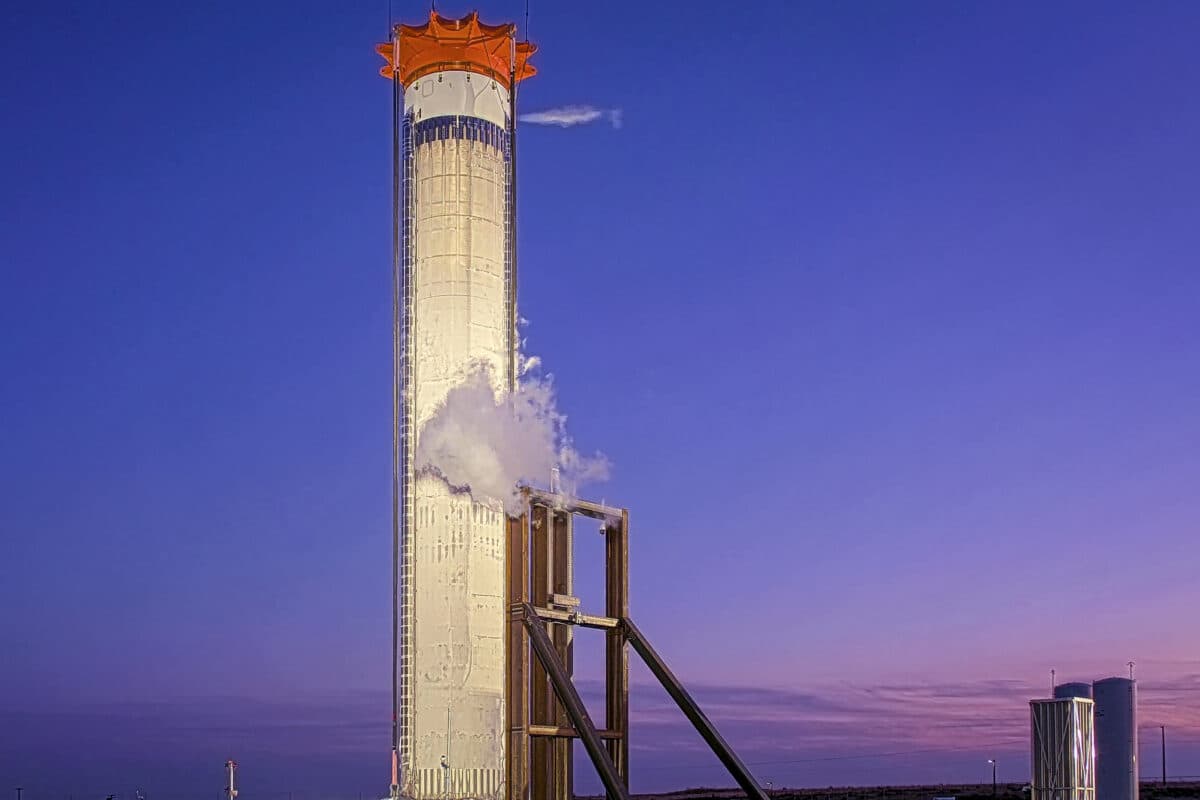
Separate hardware progress from full-reuse proof. Stage 1 testing is meaningful; the company-changing evidence is a stage that reaches orbit, returns, lands, and flies again.
Stoke says Nova Stage 1 completed proto-qualification testing in 2026, exercising structure, fluids, avionics, software, ground systems, and procedures.
The hard claim is not only launch. It is orbital-speed reentry, landing, refurbishment, payload usefulness, and reflight.
Stoke matters if a smaller launcher can prove whole-vehicle reuse outside the Starship scale and make fast transport more routine.
Why it matters
Upper stages decide whether full reuse is real.
Stoke matters because it is attacking the least-proven part of launch reuse: bringing an upper stage back from orbital-speed reentry and flying it again. Booster landing is familiar now; reusable upper stages are still the harder physics and economics.
Nova is not a proven service — the company has real hardware, funding, a Cape Canaveral pad path, and customer signals, but the thesis still depends on first flight and, eventually, upper-stage reentry, landing, and reflight. It is a case study in why full-reuse claims deserve a higher proof bar than ordinary development.
Active programs
Nova connects vehicle, heat shield, pad, and customer proof.
Nova is the key vehicle — a planned fully reusable rocket, smaller than a Falcon 9 in fully reusable mode but more ambitious in what it tries to recover. The reusable upper stage is the company-defining technology, requiring thermal protection, reentry control, and landing without giving away payload performance.
Stage 1 testing is the nearer proof lane, LC-14 is the launch-operations lane, and NSSL plus commercial customers are the demand lane.
Current status
Real hardware is visible; orbital service is not.
Stoke's strongest proof is development hardware, not service. In June 2026 it said Nova's Stage 1 completed proto-qualification at Moses Lake, exercising structure, fluids, avionics, software, and ground systems together.
Nova remains unflown, so its published payload targets are design goals until an orbital mission proves them. Serious enabling signals — LC-14 work, a Space Force NSSL Lane 1 selection, and Series D financing — support credibility but do not make Nova an operating launcher.
Watch points
The tests moving Nova from test article toward launch.
Watch integrated stage testing — static fires, tanking campaigns, structural qualification — as stronger signals than another architecture graphic. Watch the upper-stage proof path separately from the booster, since Stage 1 can progress while the harder reentry evidence waits.
Watch LC-14 readiness and a first-flight scope, plus whether NSSL tasks and commercial manifests treat Nova as more than a high-upside experiment.
How it got here
Stoke made reusable upper stages its key technical bet.
LC-14 gives the company a concrete Cape Canaveral launch-site path.
Nova Stage 1 completed proto-qualification testing in 2026, giving Stoke a real hardware milestone before first flight.
NSSL Lane 1 selection and Series D financing are seriousness signals but do not prove orbital service.
Next steps
Keep the roadmap in view
Get major space updates, set launch reminder interest, or keep exploring the Roadmap that turns space progress into a readable system.