
 Your Guide to Space
Rocket profile
Nova is the small rocket chasing the hardest reuse problem.
Nova is Stoke Space's unflown fully reusable launch vehicle. It is smaller than Falcon 9, Terran R, and Neutron, but its ambition is sharper: bring back the first stage, the fairing, and the upper stage so every major flight element can be used again.
Booster reuse is now proven in the market. Upper-stage reuse is still the harder frontier because the stage reaches orbital energy and has to return without wrecking payload performance, refurbishment time, or economics.
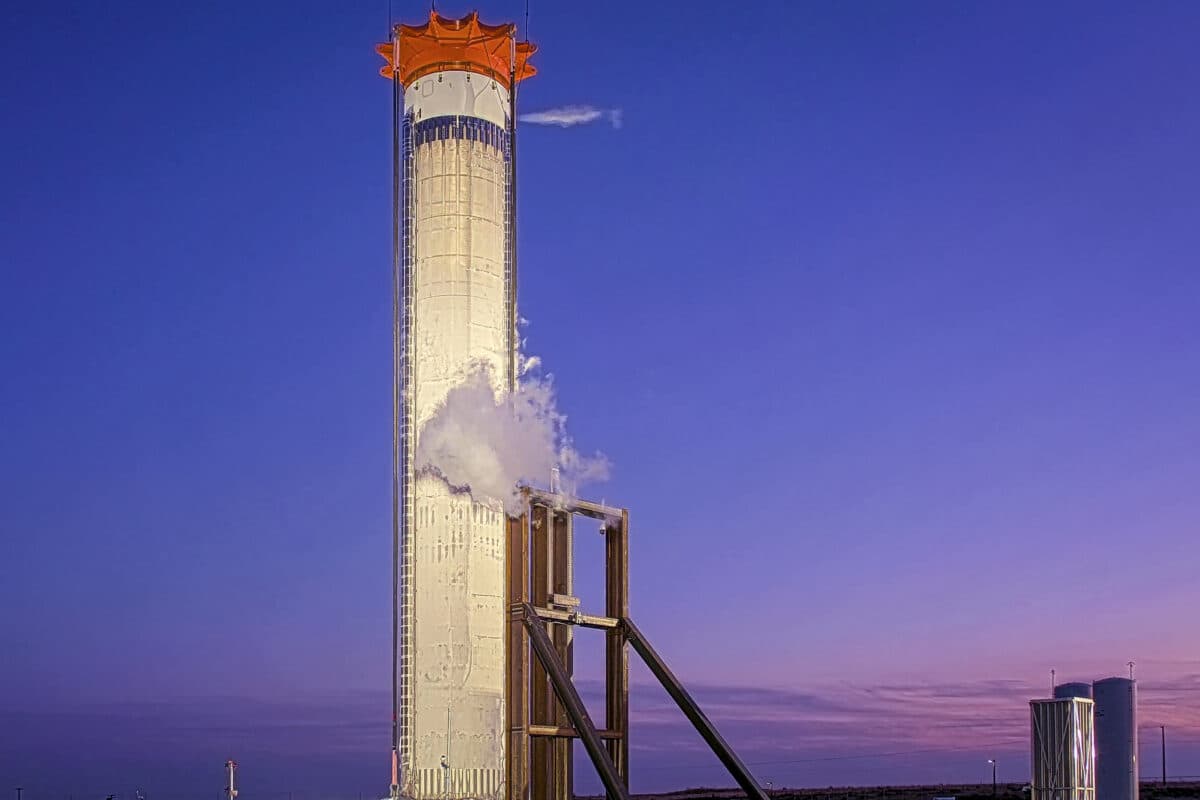
Stoke has reusable-stage test heritage, LC-14 work, NSSL selection, major financing, and a June 2026 Stage 1 proto-qualification campaign across structure, fluids, avionics, software, and operations.
Nova has not reached orbit. The central proof gates remain payload delivery, upper-stage reentry, landing, refurbishment, reflight, and whether the heat-shield approach can repeat quickly.
If Nova works, full reuse stops being only a giant-vehicle story and becomes a possible lane for smaller responsive, high-energy, and return-from-space missions.
What it is for
Nova trades raw lift for a more complete reuse claim.
Nova is not trying to out-lift Falcon 9. Stoke publishes 3,000 kg to low Earth orbit in fully reusable mode, with higher maximum LEO and high-energy mission targets. The vehicle is sized for missions where availability, direct access, return capability, and rapid reuse could matter more than sheer payload mass.
That makes Nova a useful counterpoint to the Falcon 9 era. Falcon 9 proved booster reuse can become routine, but its second stage is still expended. Stoke's bet is that the harder second-stage problem is worth solving from day one, even if the vehicle starts in a smaller payload lane.
For readers, Nova is less about one future launch date and more about an architectural question: can a smaller company make full reuse practical without needing Starship-scale payloads and infrastructure?
Capability and architecture
The hard part is bringing the upper stage home.
Fully reusable stack
Stoke describes Nova as 100% reusable: first stage, upper stage, and payload fairing. That makes the vehicle different from reusable-booster systems where the upper stage is thrown away.
Actively cooled upper stage
Nova's second stage combines a liquid hydrogen/liquid oxygen engine with an actively cooled metallic reentry heat shield. That is the appeal and the risk.
Payload targets, not flight proof
Stoke lists 3,000 kg to LEO in fully reusable mode, 7,000 kg max to LEO, 2,500 kg to GTO, 1,250 kg to TLI, and 800 kg to C3 = 0. Those are published targets.
LC-14 operating path
Space Launch Complex 14 gives Nova a concrete Cape Canaveral home, but the pad still has to line up with vehicle readiness, licensing, range flow, and customer integration.
Current status
Stoke has hardware evidence. Nova has not flown.
The strongest current proof is hardware, not service. In June 2026, Stoke said Nova Stage 1 completed proto-qualification testing at Moses Lake, verifying 46 structural objectives while exercising fluid systems, avionics, software, ground systems, and operations procedures.
Stoke also has seriousness indicators around the vehicle: the LC-14 buildout at Cape Canaveral, selection for the U.S. Space Force NSSL Phase 3 Lane 1 program, and an expanded Series D financing round that the company says brought total capital raised above $860 million.
Those indicators are useful, but none of them proves the full-reuse claim. The decisive evidence has to come from orbital flight, stage-two reentry, landing, turnaround, customer missions, and reflight.
Development history
The milestones show seriousness, not readiness.
2023: hopper and reentry-system tests
Stoke's early vertical-landing and upper-stage test work made the reusable second stage the company's defining technical story.
2024-10: SLC-14 development license
Stoke says it completed the environmental assessment and secured the license path to develop and operate Space Launch Complex 14.
2025-03: NSSL Lane 1 selection
U.S. Space Force selection lets Stoke compete for national security launch orders, a demand indicator that still depends on Nova becoming a qualified launcher.
2026-02: Series D extended to $860 million
Financing supports LC-14 activation, production capacity, and roadmap acceleration, but money is runway rather than flight evidence.
2026-06: Stage 1 proto-qualification
Stage 1 structural, fluid, avionics, software, ground-system, and operations tests are the strongest current hardware milestone.
2026: customer schedule test
Celestis lists Stoke Space for Infinite Flight from Cape Canaveral in Q4 2026. Treat that as schedule posture, not proof that Nova is ready.
What to watch next
Follow the gates that prove full reuse rather than announce it.
Stage 2 engine and heat shield
The actively cooled metallic heat shield and upper-stage engine are where Nova's full-reuse claim either becomes credible or starts to strain.
Stage 1 integration
Proto-qualification is meaningful. The next vehicle step is turning test evidence into integrated stage and launch-campaign readiness.
LC-14 readiness and licensing
Pad systems, range coordination, FAA licensing, operations rehearsals, and customer processing have to converge before first flight.
First mission profile
A first flight focused on payload delivery tells a different story from one that also attempts upper-stage return and recovery.
Reentry, landing, refurbishment
Full reuse is not demonstrated at landing. Turnaround time, inspection burden, and repeat hardware performance decide the economics.
Customer retention
Celestis, NSSL, and future customer indicators matter most if they survive schedule movement and convert into flown missions.
Next steps
Keep the roadmap in view
Get major space updates, set launch reminder interest, or keep exploring the Roadmap that turns space progress into a readable system.