
 Your Guide to Space
Rocket profile
Falcon 9 made reusable launch feel routine.
Falcon 9 is the working benchmark for modern orbital launch: a partially reusable two-stage rocket that carries Starlink, Dragon, commercial satellites, rideshare payloads, NASA missions, and national-security work often enough that reuse became normal.
The revolution is not that a booster can land once. It is that customers keep accepting reused boosters, SpaceX keeps turning the fleet around, and missions still reach orbit on a schedule that competitors have to answer.
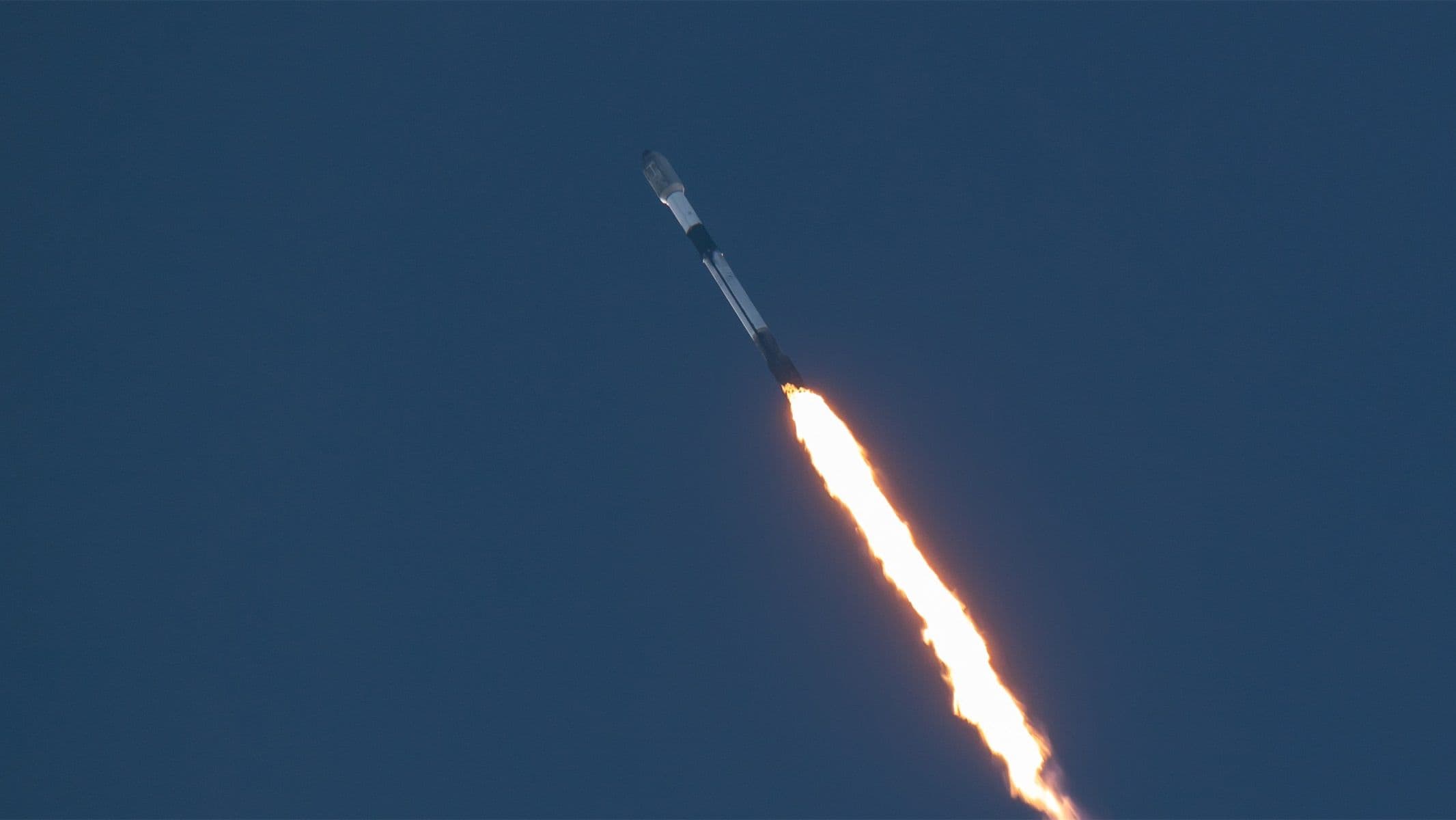
Falcon 9 has turned booster recovery, inspection, reflight, Dragon launches, Starlink deployment, rideshare, and customer missions into an operating system.
The second stage is expendable, high-energy missions can reduce recovery options, and exact pricing, margins, and booster life are not fully public.
Falcon 9 still carries the everyday space economy while Starship, New Glenn, Neutron, Terran R, and Nova work through harder proof gates.
Recent developments
Latest on Falcon 9
Falcon 9 flew Starlink 10-50 this morning, with an unusual manufacturing payload hitching a ride on the booster
Spaceflight Now reports Falcon 9 launched Starlink 10-50 from Cape Canaveral at 10:50 UTC on July 5, and SpaceX later confirmed deployment of the Starlink satellites. The same report says two semiconductor manufacturing test beds rode a brief suborbital profile on the first stage.
MRV-1 begins its journey to service aging satellites in orbit
SpaceX launched Northrop Grumman's MRV-1 mission from Cape Canaveral on July 21 at 21:15 UTC. The Falcon 9 reached its target transfer orbit and all spacecraft were reported separated; NASA subsequently said MRV-1 was en route to geosynchronous Earth orbit.
Falcon 9 launches 24 Starlink satellites after prior-day abort
SpaceX successfully launched Starlink Group 17-39 from Vandenberg at 14:49:34 UTC on July 21, 2026. The mission carried 24 satellites, and first-stage booster B1082 landed successfully on Of Course I Still Love You after its 23rd flight.
What it is for
The boring revolution is the useful one.
Falcon 9 is a medium-lift launch vehicle built around a reusable first stage and an expendable upper stage. It can fly payload-fairing missions, carry Dragon for crew and cargo, launch Starlink batches, and serve customers who need reliable access to low Earth orbit or higher-energy destinations.
Its importance is operational. Falcon 9 made launch reuse something customers could buy repeatedly, not just a landing video. That shifted the launch market from asking whether a booster can come back to asking how quickly it can be inspected, integrated with a new payload, scheduled with a range, and flown again.
Starship may be the larger bet, but Falcon 9 is the current machine that keeps many real missions moving. It gives readers a concrete standard for judging every new reuse claim.
Capability and reuse
Partial reuse works because the whole operation works.
The first stage returns to land or a droneship when mission energy allows, then moves through inspection, refurbishment, static-fire decisions, and reflight planning.
The second stage remains expendable, so Falcon 9 is not a full-reuse system. That distinction matters when comparing it with Starship or Nova ambitions.
Fairing missions, rideshare, Starlink batches, and Dragon flights use the same launch family differently. The value is fleet flexibility, not one mission type.
Cadence depends on factories, pads, ships, weather, range flow, payload readiness, and customer demand as much as it depends on the booster itself.
Current status
Operational, active, and still strategically central.
Falcon 9 is not a future promise. SpaceX public launch records show continuing Falcon 9 activity across Starlink, Dragon, commercial, civil, and government missions, while NASA crew and cargo programs keep the vehicle tied to ISS access.
The important caveat is precision. Exact launch counts, booster records, success statistics, price, and margin can go stale quickly or remain contract-specific. A public reader needs the durable conclusion, not a brittle scoreboard: Falcon 9 is the reuse cadence benchmark.
It remains relevant even if Starship succeeds, because many payloads do not need a super-heavy vehicle and many customers value an already-proven operating lane.
Flight history
The milestone was not landing. It was normalcy.
Falcon 9 first flew in 2010, then helped prove commercial cargo service to the ISS as Dragon missions matured.
The first successful orbital-class booster landing in 2015 made recovery visible, but commercial reuse in the following years made it economically meaningful.
Crew Dragon Demo-2 in 2020 made Falcon 9 part of the U.S. human spaceflight backbone from American soil.
Starlink cadence turned Falcon 9 into the repeat-operations baseline: the vehicle became infrastructure, not just a rocket.
What to watch next
Watch the operating system, not only the rocket.
Booster flight-count records, inspection intervals, and any public sign that refurbishment is getting easier or harder.
How quickly Starlink demand shifts to Starship once Starship is a dependable payload vehicle rather than a test campaign.
Crew Dragon, cargo Dragon, NASA, and national-security missions, because high-trust customers show where Falcon 9 remains the safe default.
Rare anomalies and recovery misses. Mature systems are judged not only by success, but by investigation, correction, and return to cadence.
Next steps
Keep the roadmap in view
Get major space updates, set launch reminder interest, or keep exploring the Roadmap that turns space progress into a readable system.