
 Your Guide to Space
Rocket profile
Electron is the small rocket that still has a job.
Electron is Rocket Lab's operational small orbital launcher: a carbon-composite rocket built for dedicated smallsat missions, precise deployment, responsive launch, and customers who value control over pure price per kilogram.
Do not judge Electron only by payload mass. Its real product is mission control: a customer can buy a specific date, orbit, deployment sequence, and launch campaign instead of waiting for a larger rideshare mission to line up.
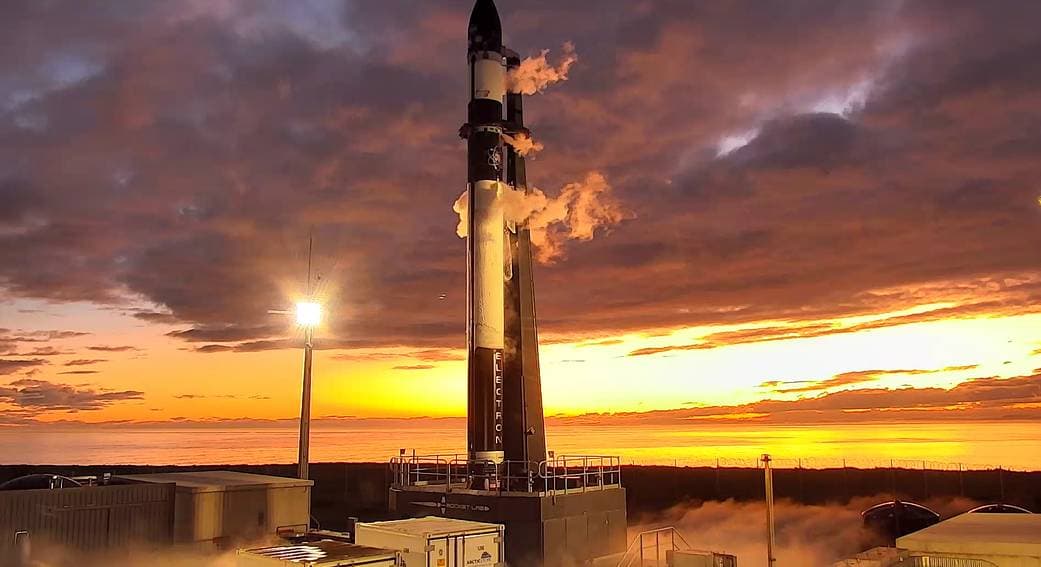
Rocket Lab's official Electron page publishes current launch and satellite-deployment totals, and the mission archive shows why Electron is one of the rare small launchers with a durable operating record.
Electron recovery experiments matter, but routine booster reuse is not the proven value proposition. Dedicated small launch also faces constant rideshare price pressure.
Electron gives Rocket Lab launch cadence, customer trust, mission operations, and production discipline while Neutron carries the bigger reusable medium-lift ambition.
Recent developments
Latest on Electron
Rocket Lab’s secretive Curveball suborbital mission succeeds
Rocket Lab successfully launched the government-classified Curveball mission on a suborbital HASTE flight from Wallops Flight Facility. The supplied record reports liftoff and launch success, while mission details remain to be announced.
Rocket Lab targets July 1 Electron launch for iQPS radar satellite mission
Rocket Lab is targeting 2026-07-01 01:00 UTC for an Electron launch from Launch Complex 1A in Mahia, New Zealand, carrying the Earth science mission "The Grain Goddess Provides (iQPS Launch 7)." The launch is currently listed as Go for Launch, though recent updates show at least one weather-related slip before the current T-0.
What happened with Electron | Ten Owl Of Ten (StriX Launch 10)
Electron | Ten Owl Of Ten (StriX Launch 10) is now in post-launch review. The latest cached status is launch successful.
What it is for
Small launch survives when control is worth paying for.
A small payload can often buy a cheaper seat on a larger rocket, but that is not always the best mission. Earth-observation satellites, defense demonstrations, science payloads, technology demos, and constellation pathfinders may need a particular orbit, a tighter launch window, or a deployment sequence that rideshare cannot easily provide.
That is Electron's lane. It is not trying to lift the most mass. It is trying to make a small spacecraft the primary customer instead of one passenger among many. That difference can matter when the satellite is time-sensitive, orbit-sensitive, or small enough that a delayed rideshare would slow the entire mission.
Electron also explains Rocket Lab's credibility. Neutron is still a development program, but the company behind it has already run a real orbital launch service with commercial, NASA, defense, and technology-demonstration customers.
Capability and mission design
The small rocket is only part of the product.
Rocket Lab lists Electron at up to 300 kg to low Earth orbit, which puts it below medium-lift rockets but directly in the dedicated smallsat lane.
Rutherford engines use electric pumps, a distinctive architecture that helped Rocket Lab simplify turbomachinery for a small, production-oriented launch vehicle.
The Kick Stage gives Electron more mission-design value after ascent: circularization, deployment timing, multi-payload sequencing, and Photon-adjacent hosted mission options.
Launch Complex 1 in New Zealand and Launch Complex 2 in Virginia give Rocket Lab a private-range cadence advantage plus a U.S. path for government and responsive-space missions.
Current status
Operational service, with reuse kept in proportion.
Electron is operational. Rocket Lab's official pages now present Electron as an active small-launch service with frequent mission updates, a mission archive, dedicated launch-site infrastructure, and a launch count that changes often enough to treat exact numbers as a source-check item.
The reuse story needs more care. Rocket Lab has pursued recovery, ocean splashdown, booster inspection, and reuse learning, and its reusable-rockets material keeps that work visible. But Electron is not a Falcon 9-style routine reuse system in public service.
HASTE extends Electron heritage into suborbital hypersonic and test missions, which gives Rocket Lab a defense and research lane next to orbital small launch without making HASTE the same product as Electron.
Flight history
Electron turned small launch from pitch into service.
The 2017 test flight reached space but not orbit; the 2018 orbital success proved Rocket Lab could move from demonstration to a commercial small-launch path.
CAPSTONE showed why dedicated small launch can matter: a compact NASA lunar-pathfinder mission got a tailored launch and deployment path instead of disappearing into a larger manifest.
Launch Complex 2 brought Electron into U.S. orbital operations from Virginia, giving government customers another access path while Launch Complex 1 continued high-cadence New Zealand flow.
Recovery attempts, splashdowns, reused components, and HASTE missions make Electron a learning platform as well as a commercial rocket, but the main proof remains paid orbital service.
What to watch next
Follow demand, cadence, recovery, and the Neutron handoff.
Official launch-count and satellite-deployment updates, because Electron's strongest claim is a living operating record rather than a one-time demonstration.
Customer mix: Earth observation, defense, science, demos, and constellation replenishment reveal whether dedicated launch demand stays broad enough.
Recovery and reuse experiments, especially whether recovered hardware becomes routine flight hardware or remains a learning program around an expendable service.
How Neutron changes the business. If Neutron works, Electron becomes the small-mission lane inside a larger Rocket Lab launch portfolio rather than the company's ceiling.
Next steps
Keep the roadmap in view
Get major space updates, set launch reminder interest, or keep exploring the Roadmap that turns space progress into a readable system.