
 Your Guide to Space
Rocket profile
Neutron is Rocket Lab's second act in reusable launch.
Neutron is Rocket Lab's reusable medium-lift rocket in development: a methane-powered vehicle aimed at constellation deployment, national security missions, commercial satellites, cargo concepts, and the market space Electron is too small to serve.
Read it as Falcon 9-class market ambition, not Falcon 9-level proof. Rocket Lab has real operating credibility from Electron and spacecraft work, but Neutron still has to prove first flight, recovery, refurbishment, reflight, and customer cadence.
Electron gives Rocket Lab a real launch-operations baseline, and its space-systems business shows the company can build more than one narrow slice of a mission stack.
Neutron has not flown. First launch, stage recovery, fairing behavior, refurbishment, reflight, and customer mission assurance are still ahead.
If it works, Neutron gives constellation operators and government buyers another reusable option between small dedicated launch and today's dominant medium-lift provider.
What it is for
Neutron is Rocket Lab scaling up after Electron.
Electron made Rocket Lab credible by serving small satellites that need dedicated timing and tailored orbits. Neutron is the company trying to carry that operating discipline into a bigger market: multi-satellite deployments, national-security payloads, commercial spacecraft, civil science, cargo concepts, and eventually missions that need more volume and mass than Electron can offer.
That makes Neutron strategically different from a purely speculative rocket startup. Rocket Lab already knows launch operations, customers, factories, spacecraft hardware, and range flow. The hard question is whether those advantages scale to a seven-meter first-stage diameter, methane engines, larger composite structures, captive fairings, landing dynamics, and mission-assurance expectations.
The useful framing is simple: Neutron is one of the most credible reusable medium-lift challengers, but it is still a development rocket until flight and reuse evidence exists.
Capability and reuse
The distinctive parts are the engine, fairing, and return loop.
Rocket Lab lists Neutron at 13,000 kg to low Earth orbit and 1,500 kg to Mars or Venus, putting it in the useful medium-lift class for constellations and high-energy missions.
Nine Archimedes engines power Stage 1, with a vacuum-optimized Archimedes on Stage 2. That is a major step beyond Electron's Rutherford engine family.
The Hungry Hippo captive fairing is designed to open, deploy the upper stage and payload, close again, and return with Stage 1 instead of becoming separate expendable hardware.
Neutron is designed for return-to-launch-site and downrange landing options, but the useful proof is not a diagram. It is a recovered stage that can be inspected, refurbished, and flown again.
Current status
Close to first flight is not the same as operational.
Rocket Lab's current Neutron materials show real progress: Launch Complex 3 is complete, Hungry Hippo has cleared qualification and arrived in Virginia, Stage 2 and Stage 1 are listed as ready for flight, Archimedes engine qualification is listed as complete, and regulatory approval is now part of the public path-to-liftoff timeline.
The caution is also well-sourced. In January 2026, Rocket Lab said a Stage 1 tank qualification test ruptured during a hydrostatic pressure trial and that schedule impact would depend on the test review. Development programs learn through tests, but those tests still belong in the public status story.
The remaining public gates are the integrated flight vehicle, Stage 2 static fire, Stage 1 static fire, wet dress rehearsal, launch, recovery attempt, post-flight inspection, and the first evidence that reused hardware can support a second mission.
Development history
The story is a scale jump with visible proof gates.
Rocket Lab introduced Neutron in 2021 as the growth vehicle after Electron: larger payload class, reusable first stage, and a role in constellation, civil, commercial, and national-security launch.
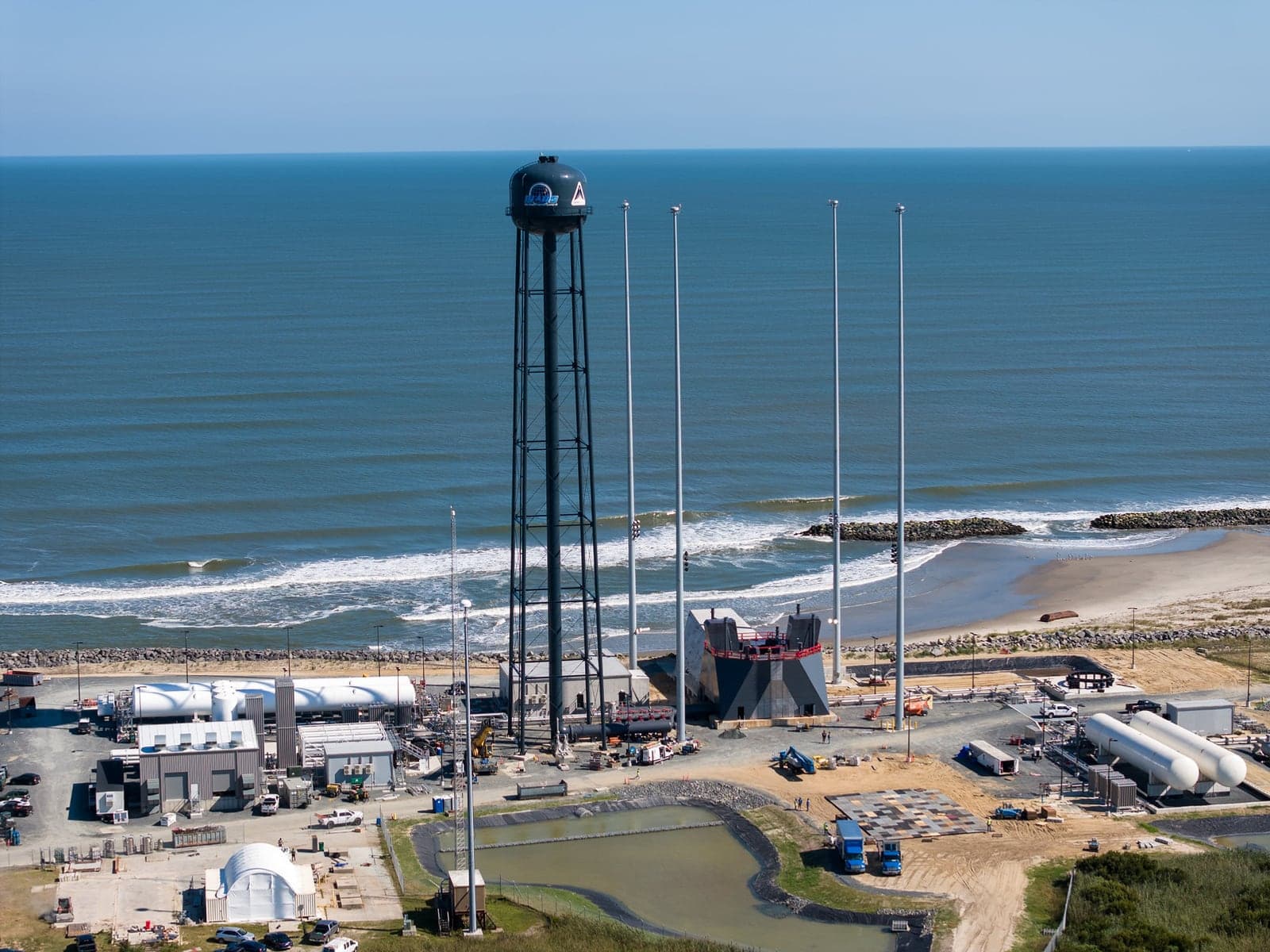
Wallops made the U.S. launch path concrete. LC-3, the Assembly and Integration Complex, and nearby Electron operations give Neutron a real launch-site ecosystem rather than a detached render.
Archimedes hot-fire, stage-structure testing, fairing qualification, and flight-mechanism work show the program moving through real hardware gates you can track.
The multi-launch confidential-customer contract gives Neutron market evidence before first flight, but customer demand only becomes operating proof after payloads reach orbit on schedule.
What to watch next
Follow the events that turn architecture into service.
Integrated static fires for Stage 2 and Stage 1, because those tests connect flight engines, tanks, avionics, ground systems, and operations before launch day.
Wet dress rehearsal and final launch-readiness flow at LC-3, especially whether Rocket Lab gives a conservative first-flight profile or tries to gather recovery data early.
First mission outcome: reaching orbit, deploying a payload, any recovery attempt, and how openly Rocket Lab discusses post-flight inspection.
Customer cadence after the inaugural launch. A few announced bookings are useful, but repeat manifest conversion is what would make Neutron a real market alternative.
Next steps
Keep the roadmap in view
Get major space updates, set launch reminder interest, or keep exploring the Roadmap that turns space progress into a readable system.