
 Your Guide to Space
Mission
Satellite Internet & Megaconstellations
Satellite internet is where space infrastructure has already become a mass-market service, but it also forces hard questions about orbital traffic, spectrum, astronomy, and replacement cadence.
direct-to-cell limits, terminal readiness, spectrum decisions, collision avoidance, disposal evidence, brightness mitigation, and replacement cadence

Why it matters
Megaconstellations are already public space infrastructure.
Satellite internet is one of the few mission areas where ordinary users already feel space infrastructure directly. Starlink proved that low Earth orbit broadband can become a real service, and Amazon Leo is the clearest test of whether a second large network can turn launch contracts and terminals into coverage.
The harder question is how to judge a service that needs thousands of spacecraft, ground antennas, software routing, spectrum rights, customer support, collision avoidance, and constant replenishment. A working network is not a single spacecraft; it is an operating system spread across orbit and Earth.
Megaconstellations count as missions here because they are not one launch. They are recurring operations: factories, ground terminals, regulatory approvals, replenishment flights, customer service, and stewardship of shared orbits.
The pieces in play
A megaconstellation only works when the whole stack works.
The useful way to read this category is by layers. Spacecraft have to be built in batches, launched into the right orbital shells, connected through gateways or laser links, sold through terminals, and replaced before failures thin the network.
That makes the customer promise inseparable from operations. Better coverage can come from more satellites, smarter routing, lower-cost terminals, carrier partnerships, or cleaner regulatory approvals, and each improvement changes the service in a different way.
Direct-to-cell claims need special care. Emergency or messaging coverage, app data, voice, device compatibility, and full mobile broadband are different milestones, even when they sit under the same marketing phrase.
batch-built spacecraft
Batch-built spacecraft make broadband a production problem, not only a launch event.
Manufacturing scale is visible when spacecraft leave the factory fast enough to populate orbital shells before the market moves on.
continuous launch and replenishment
Continuous replenishment decides whether coverage improves or slowly decays as satellites age and fail.
Replenishment cadence matters because satellites have finite lives; maintenance and upgrades become part of the service promise.
gateways and laser-link routing
Gateway stations, laser links, and routing software determine whether satellites become a resilient network.
Ground and optical links turn many spacecraft into a network by moving traffic around weather, geography, congestion, and outages.
user terminals and direct-to-cell limits
User terminals and direct-to-cell limits decide what customers can actually do with the service.
Terminals are the customer interface; lower cost, easier installation, and clearer mobile limits can matter as much as satellite count.
collision avoidance, disposal, and astronomy mitigation
Collision avoidance, disposal, and brightness mitigation decide whether scale remains responsible.
Stewardship evidence turns sustainability claims into something measurable: maneuver records, disposal success, brightness reduction, and failure reporting.
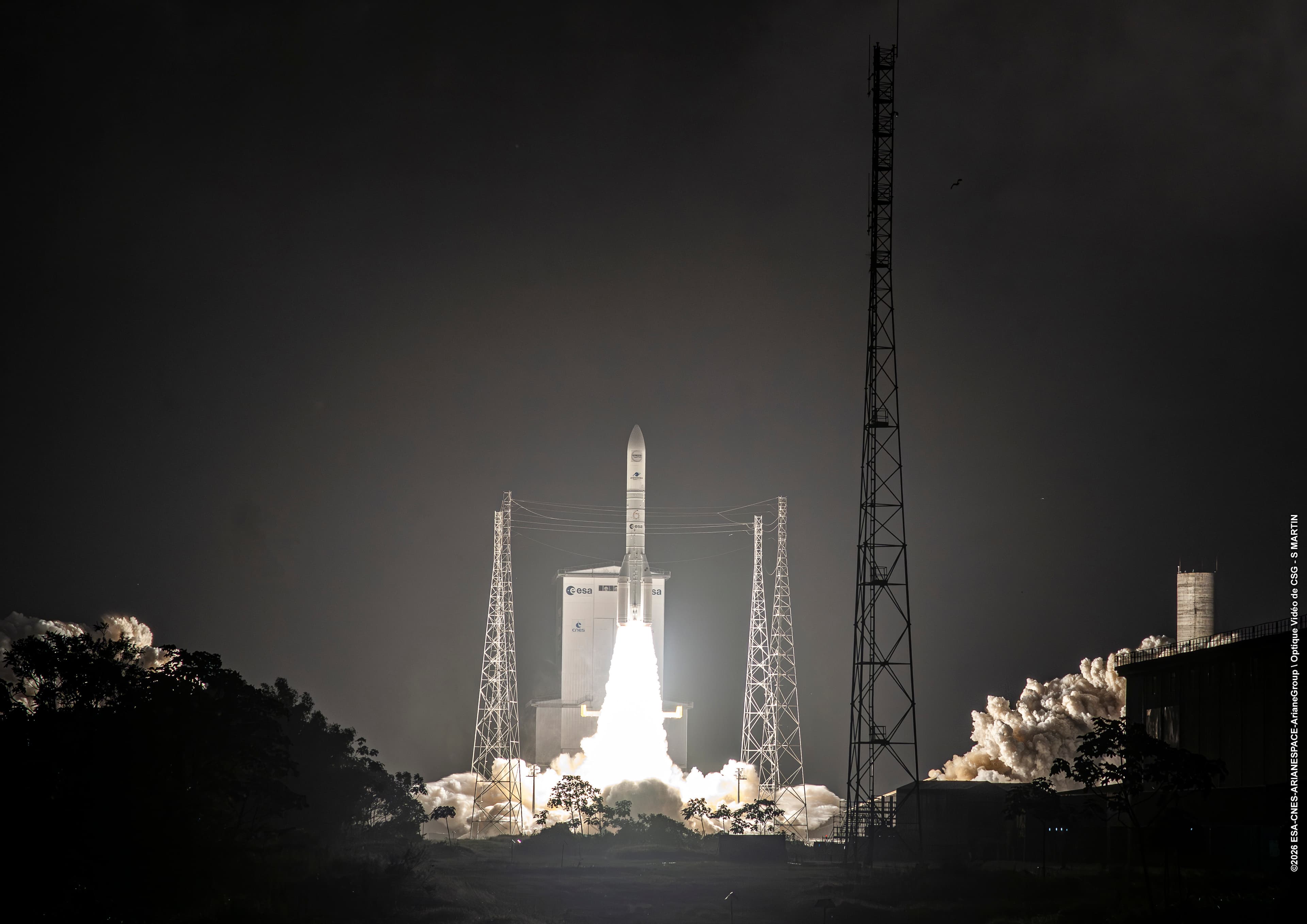
What the image shows
Constellations turn service into launch demand.
A launch image shows the pipeline behind the service. Broadband coverage depends on spacecraft leaving the factory, being packed for flight, reaching the right shell, joining the network, and being replaced often enough that customer service does not decay.
Already real
Low Earth orbit broadband is no longer only a concept.
Several pieces have moved from theory into operating practice: compact flat-panel user terminals, phased-array antennas, rapid satellite production, software-managed routing, frequent replenishment launches, and network operations that can support real customers instead of one-off demonstrations.
The remaining challenge is less glamorous but more important: whether operators can maintain service quality, publish credible disposal and brightness records, coordinate spectrum, report failures honestly, and keep the replacement cycle from turning useful low Earth orbit into a harder place to share.
Service at scale
low Earth orbit broadband has moved from a promise into something ordinary customers, enterprises, and remote users can buy.
Operations stack
terminals, gateways, phased arrays, routing software, launch cadence, and customer support now matter as much as spacecraft counts.
Regulatory constraint
spectrum, debris, astronomy, and direct-to-cell approvals are key operating constraints, not paperwork after the engineering is done.
Still to prove
Scale creates policy, astronomy, debris, and replacement questions.
A constellation can work for customers and still create unresolved public costs. The next standard is responsible growth: collision avoidance, transparent disposal, brightness mitigation, spectrum coordination, and honest failure-rate reporting.
The open question is whether operators can make service better without making low Earth orbit harder to share. That means regulators, astronomers, launch providers, mobile carriers, and satellite operators all belong in the same story.
- 01Consumer benefit
Will competing constellations create durable service improvements or mainly add more orbital traffic?
- 02Orbital stewardship
Can operators prove responsible disposal, collision avoidance, astronomy mitigation, and transparent failure rates?
- 03Replacement rhythm
How much launch demand remains after first deployment becomes maintenance, upgrades, and failure recovery?
Worth watching
Watch service rollout and orbital stewardship together.
Useful updates show both the customer side and the public side: coverage opened, terminal costs changed, direct-to-cell limits clarified, spectrum conditions updated, collision-avoidance evidence improved, or satellite disposal performance became more transparent.
A mature constellation update gives numbers and consequences. It explains whether new satellites are expanding coverage, replacing aging hardware, testing a new shell, improving mobile service, or reducing the risk that useful orbits become more crowded for everyone else.