
 Your Guide to Space
Rocket profile
Ariane 6 is Europe's autonomy rocket in a reuse-shaped market.
Ariane 6 is the European Space Agency's new expendable launch family, built by ArianeGroup, launched from French Guiana, and operated commercially by Arianespace. Its job is to restore dependable European access to orbit for sovereign payloads, commercial customers, and institutions that cannot treat launch as somebody else's strategic dependency.
Europe does not need Ariane 6 because it is the cheapest rocket on Earth. It needs Ariane 6 because navigation, Earth observation, defense, climate data, science, and commercial connectivity become fragile if Europe has no launcher it can task, govern, improve, and sustain through its own institutions.
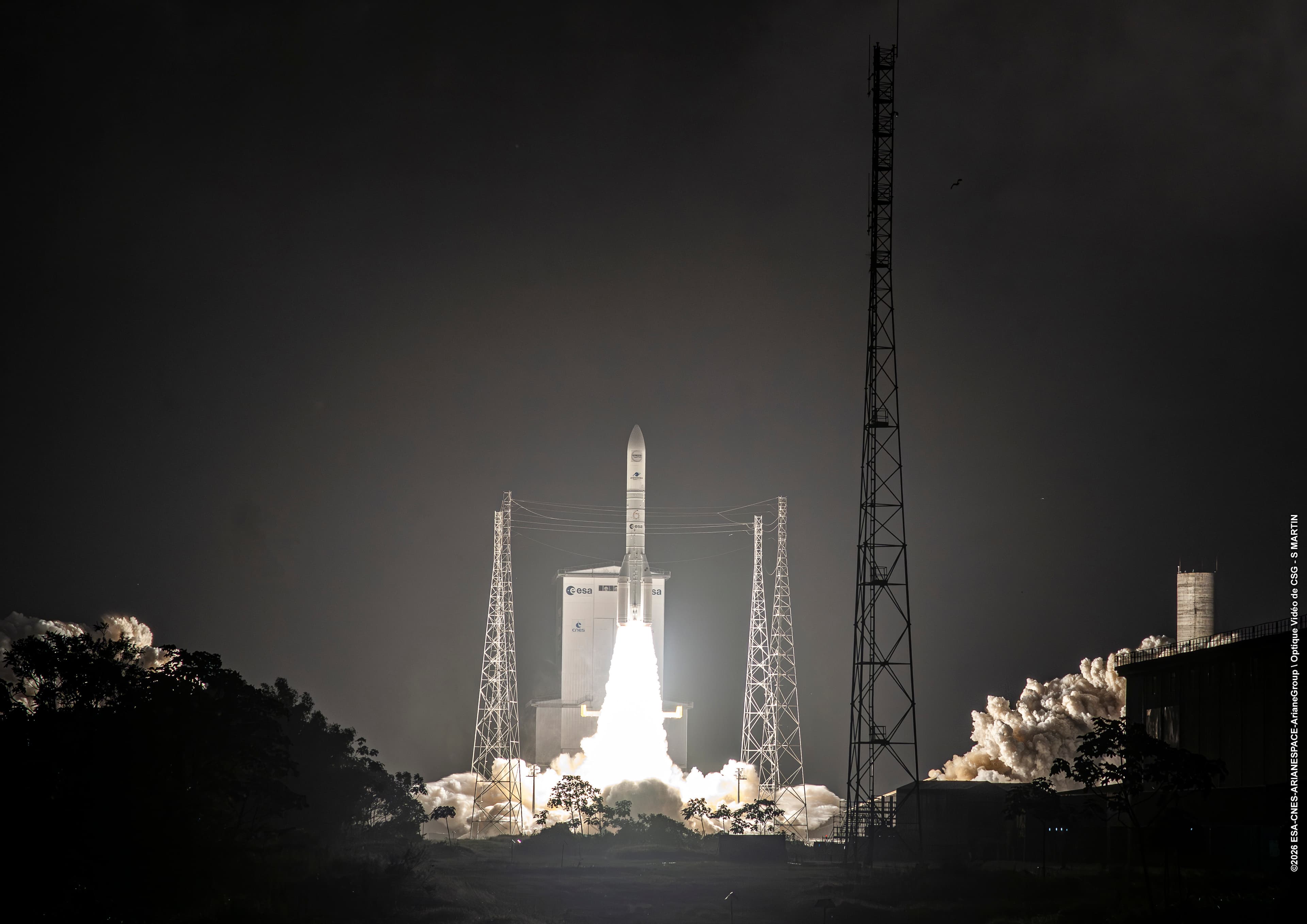
Ariane 6 has moved past demonstration: Arianespace flew the CSO-3 defense satellite on the first commercial mission, then ESA and Arianespace logged repeated Amazon Leo Ariane 64 missions in 2026.
The rocket still has to show that production, launch operations, pricing, upper-stage behavior, and customer confidence can hold up while reusable competitors keep resetting market expectations.
Ariane 6 is Europe's near-term access-to-space bridge. The bigger strategy question is how Europe pairs that bridge with reusable launch development instead of treating expendability as the final answer.
What it is for
Ariane 6 is infrastructure before it is a market disruptor.
Ariane 6 replaced Ariane 5 because Europe needed a new heavy-launch family after Ariane 5 retirement, Soyuz access disappeared from the European launch mix, and institutional payloads still needed a European path to orbit. The useful way to read the vehicle is not as a Falcon 9 copy. It is Europe rebuilding a dependable launcher it can assign to European missions.
That role is visible in the manifest: defense Earth observation, Galileo navigation, Copernicus and Sentinel Earth data, weather satellites, ESA science, and commercial constellation payloads such as Amazon Leo. Some of those customers can buy launch globally, but Europe cannot outsource every critical mission and still call the result strategic autonomy.
The tension is that autonomy alone does not make a rocket competitive. Ariane 6 has to become reliable enough for governments and efficient enough for customers who compare it against reused Falcon boosters and emerging heavy-lift alternatives.
Capability and architecture
The vehicle is modular, but not reusable.
Ariane 62 uses two strap-on boosters for smaller institutional and commercial missions. Ariane 64 uses four boosters for heavier payloads and constellation deployment work.
The core stage uses Vulcain 2.1, while the upper stage uses the restartable Vinci engine. For multi-satellite deployment, safe deorbit, and mission flexibility, the upper stage is central to the product.
The P120C booster family ties Ariane 6 to Vega-C supply-chain logic. VA269 introduced P160C-based boosters with more propellant and higher performance for the Amazon Leo mission.
Ariane 6 is expendable in current service. Reusable European vehicles and demonstrators are strategically important, but they are not Ariane 6's operating proof.
Current status
Flying, improving, and still earning rhythm.
Ariane 6 first flew in July 2024. The more relevant customer-ready story is what came after: the March 2025 CSO-3 mission marked Arianespace's first commercial Ariane 6 operation, putting a French defense Earth-observation satellite into orbit.
In 2026, Ariane 64 moved into visible constellation work. ESA's VA268 source describes 32 Amazon Leo satellites launched from Europe's Spaceport and an upper-stage deorbit sequence after payload separation. On June 17, 2026, ESA said VA269 placed 36 more Amazon Leo satellites into orbit using P160C-based boosters.
That is meaningful operating evidence. It still leaves the harder questions open: can Ariane 6 launch often, keep institutional missions from backing up, win enough commercial work, and evolve while reusable rockets keep improving?
Flight history
Ariane 6 went from access gap to operating proof.
Ariane 5 left Europe with a transition problem: a successful legacy heavy launcher retired before its successor had settled into routine service.
Ariane 6's July 2024 first flight proved the new vehicle could leave the pad and perform a demonstration mission, but it did not yet prove commercial cadence.
CSO-3 in March 2025 made the commercial-operation story concrete: Ariane 6 served a defense customer in the two-booster Ariane 62 configuration.
Amazon Leo flights in 2026 showed why Ariane 64 matters: constellation customers value payload mass, schedule confidence, and repeat launches as much as first-flight symbolism.
What to watch next
Follow cadence, customers, and the reusable answer.
Whether Ariane 62 and Ariane 64 missions keep arriving without long gaps. A sovereign launcher only solves the access problem if it becomes a dependable service.
P160C booster performance after VA269. More payload per launch is valuable only if the upgraded booster path becomes reliable and repeatable.
Vinci upper-stage behavior: restarts, deployment precision, and disposal burns are where multi-payload missions and debris posture turn into proof.
Customer mix after Amazon Leo, Galileo, Copernicus, defense, and weather missions. Institutional demand is the floor; commercial wins show whether Ariane 6 can compete beyond that floor.
Europe's reusable launcher decisions. Ariane 6 can restore autonomy, but the next decade will ask whether Europe can pair autonomy with lower-cost reusable operations.
Next steps
Keep the roadmap in view
Get major space updates, set launch reminder interest, or keep exploring the Roadmap that turns space progress into a readable system.