
 Your Guide to Space
Agency profile
ESA is Europe's route into shared space infrastructure.
The European Space Agency is not only a launch story. ESA gives Europe independent access ambitions, Artemis hardware, lunar service plans, Earth-observation data, science missions, and a coordinated industrial base.
Read ESA through autonomy and partnership: Europe wants its own launch path, but many of its highest-leverage contributions work because they plug into NASA, EU, and international systems.
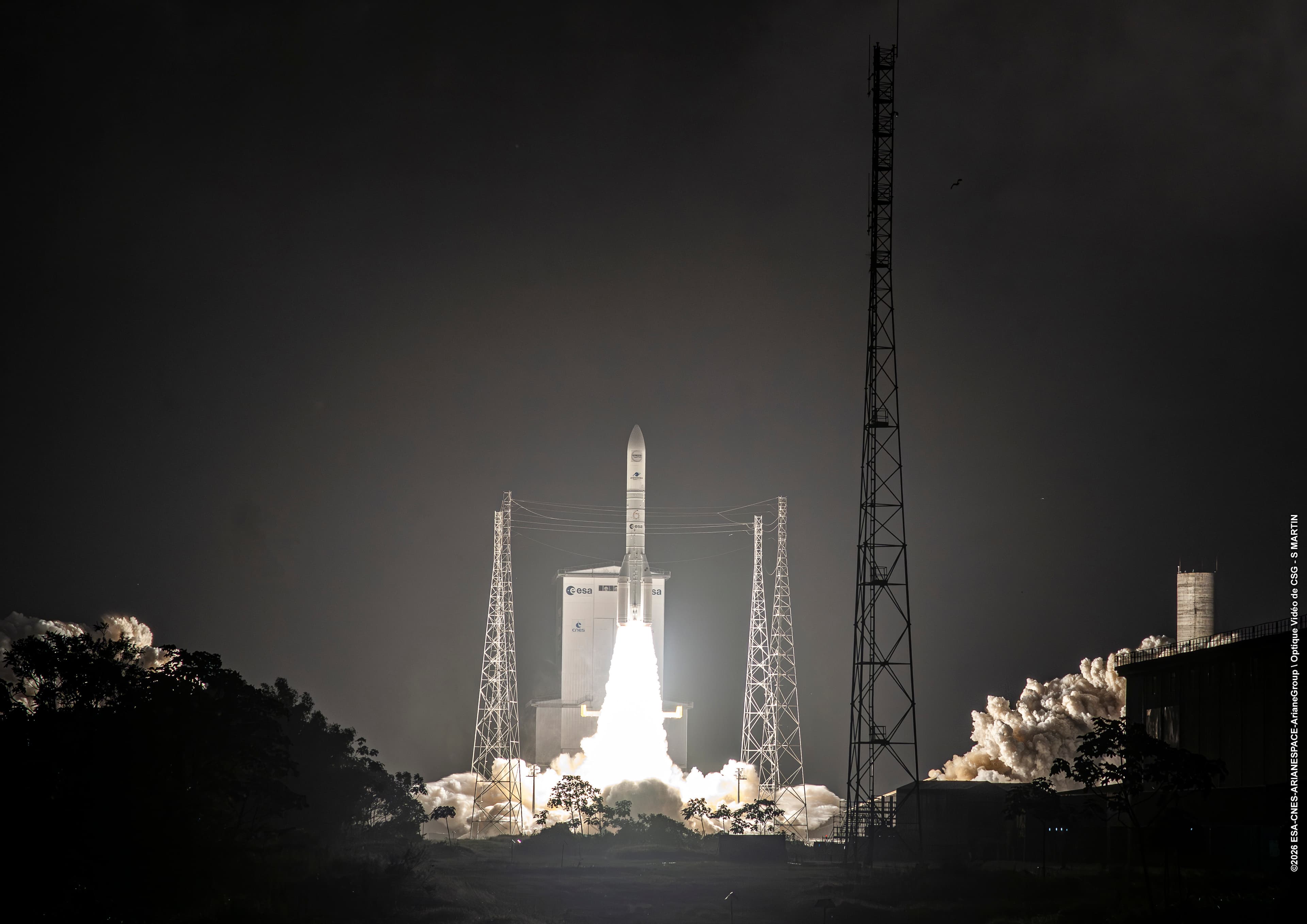
ESA has visible operating evidence in Earth observation, science missions, Orion service modules, and Ariane 6 moving beyond first flight into customer launches.
The next proof gates are repeat Ariane 6 operations, Moonlight service milestones, Argonaut funding and hardware, and Gateway integration.
ESA matters when European systems become durable parts of shared exploration, climate, science, and launch infrastructure.
The quick read
ESA: the quick read.
A few fast facts to get oriented before the deeper story on what it builds, what still has to work, and where it is headed.
European launch access, exploration partnerships, Earth observation, science missions, and international program contributions.
Where the work happens
Watch Ariane 6 cadence, Earth-observation programs, lunar contributions, and science missions.
Recent developments
Latest on ESA
Artemis reaches 70 partners, with hardware cooperation behind the signatures
Mauritius became the 70th Artemis Accords signatory after Serbia joined as member 69. ESA’s crew visit to ESTEC showed how that diplomatic network connects to flight hardware.
JAXA and ESA cooperate on planetary defense and RAMSES mission
JAXA and ESA signed a broader memorandum of cooperation along with a specific mission agreement for RAMSES, enhancing their collaboration in planetary defense efforts.
Why it matters
What changes when Europe has its own space lane?
ESA matters because space progress is not only a U.S. or a company story. The agency converts the priorities of European nations into launch access, science, Earth observation, and human-exploration hardware that plugs into global campaigns.
The easy mistake is to read ESA only through Ariane 6. Launch autonomy is key, but ESA also builds the service module that powers Orion on Artemis, contributes to Gateway, and runs the Copernicus missions that monitor the planet.
Active programs
ESA spans launch autonomy, lunar systems, and public data.
Ariane 6 and Vega-C are Europe's access to space. Orion service modules and Gateway contributions are its bridge into crewed deep space. Moonlight aims at lunar communications and navigation; Argonaut is a planned European cargo lander for the 2030s.
And Copernicus, Euclid, Juice, Hera, and the rest of ESA's science fleet are where the agency's value is easiest to see: climate data, planetary defense, and open science.
Current status
Launch cadence is the near-term test.
Ariane 6 has moved from debut uncertainty into real operations, including flights for Europe's own satellites and Amazon's Leo constellation, so reliability and cadence are the questions that matter now.
The exploration side is active but depends on partners: ESA's service module powered Orion during Artemis II, and programs like Moonlight and Argonaut connect Europe to the next lunar layer — though their timing rides on NASA's architecture and European funding.
Watch points
Look for proof that autonomy becomes dependable service.
Watch Ariane 6 fly repeatably and keep booking customers. Watch the Artemis-linked hardware — Orion service modules, Gateway contributions, European astronaut assignments — and any architecture change that moves Europe's role.
And watch Copernicus and the science missions, because that is where ESA's public value shows up first: climate monitoring, disaster response, and planetary science.
How it got here
Ariane 6 first flew in July 2024 and is now in the cadence/reliability proof phase.
Ariane 6 flights in 2026 are turning Europe's launch-autonomy question from first flight into schedule, customer, and performance evidence.
ESA programs keep European exploration, science, and Earth-observation capacity connected to global partnerships.
European contributions appear across lunar, station, and science-roadmap stories.
Keep exploring
How Rocket Launches Work
How Rocket Launches Work: A countdown-to-orbit guide that explains weather, fueling, max Q, staging, fairings, orbit insertion, payload deployment, and scrub logic.
Reusable Rockets
Why Reusable Rockets Matter: A guide to booster reuse, ship reuse, refurbishment, launch cadence, cost evidence, and why landing is only one part of reusability.
Why the Moon Matters
Why the Moon Matters: A guide to why lunar missions matter for technology, science, geopolitics, operations, resources, and Mars preparation.
Artemis Explained
Artemis Explained: A guide to SLS, Orion, Gateway, Human Landing System, spacesuits, surface logistics, and how the Artemis missions build on each other.
Who Regulates Spaceflight
Who Regulates Spaceflight: A guide to launch licensing, range safety, spectrum, remote sensing, exports, reentry, planetary protection, and international coordination.
Next steps
Keep the roadmap in view
Get major space updates, set launch reminder interest, or keep exploring the Roadmap that turns space progress into a readable system.