
 Your Guide to Space
Rocket profile
SLS is the Artemis spearpoint, not the reuse revolution.
NASA's Space Launch System is a government-owned, contractor-built super-heavy rocket for one high-consequence job: launch Orion and crew beyond low Earth orbit for Artemis. It is powerful, expendable, politically durable, and economically unlike the reusable launch systems reshaping the rest of the market.
SLS has done the thing NASA built it to do: send Orion around the Moon and bring a crewed Artemis mission home. The public question now is whether that proof can become repeatable enough, affordable enough, and flexible enough for the rest of the Moon-to-Mars campaign.
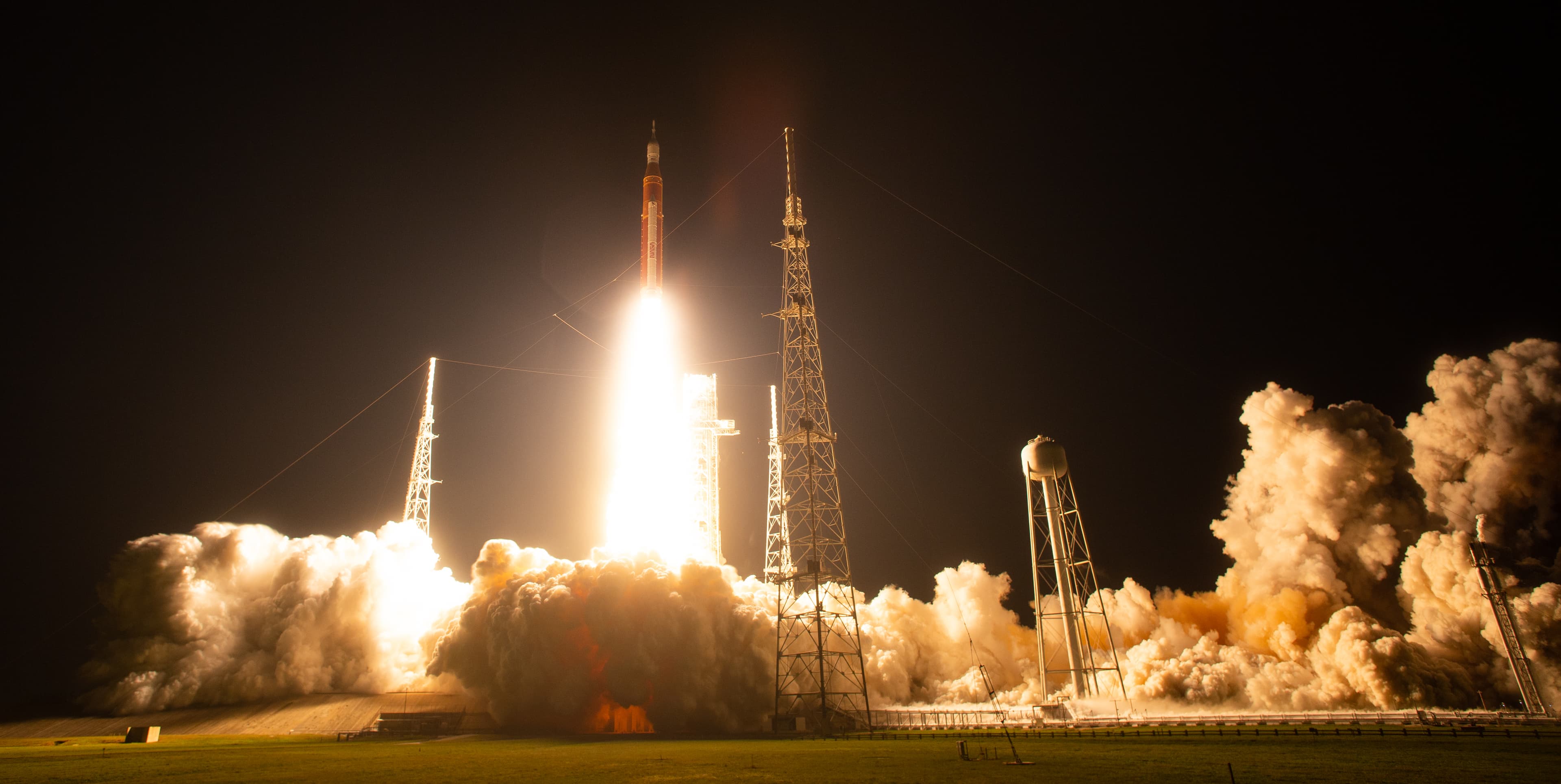
Artemis I proved uncrewed SLS/Orion lunar flight. Artemis II added crewed flight evidence for the rocket, Orion, ground systems, recovery forces, and mission operations.
A rocket can be mission-critical without being cheap or frequent. SLS still has to show that its core stages, boosters, RS-25 engines, mobile launch infrastructure, and budgets can support the roadmap.
SLS and Orion get crew toward lunar space. Landers, suits, Gateway, cargo, surface power, and commercial systems decide whether Artemis becomes sustained exploration.
Recent developments
Latest on Space Launch System
Artemis lander plans drew fresh scrutiny as former NASA leadership publicly questioned the program’s approach
A fresh Space.com report led with criticism from a former NASA chief who questioned Artemis moon lander plans, reviving debate around how NASA is structuring lunar landing elements for the.
What it is for
SLS is a crewed exploration launcher first.
SLS is easy to misread if every rocket is judged by Falcon 9 or Starship economics. It is not a commercial launch service competing for the broadest market. It is NASA's dedicated deep-space crew launch stack: SLS, Orion, the launch abort system, Kennedy ground systems, mission control, recovery teams, and a contractor base that has to move together.
That makes the vehicle both valuable and constrained. It gives NASA a government-controlled way to send astronauts beyond low Earth orbit, but it is expendable, slow to produce, and tied to annual appropriations and large industrial workflows.
The clearest way to understand SLS is not as the rocket that makes lunar settlement cheap. It is the rocket that keeps the early crewed Artemis campaign physically possible while other systems try to make the campaign sustainable.
Capability and architecture
The rocket is only one part of the Artemis launch stack.
Four RS-25 engines and two large solid rocket boosters give SLS its launch energy. Much of that hardware lineage comes from Shuttle-era engineering, updated for Artemis.
Orion sits on top for crew missions. That means SLS performance, Orion life support, abort capability, ground systems, recovery, and mission rules all have to clear the same readiness gate.
Block 1 has flown the opening Artemis missions. Block 1B and the Exploration Upper Stage promise more payload capability, but their timing and role remain architecture and budget watch items.
SLS is expendable. That is the central tradeoff: high-energy, crew-rated government launch in exchange for low cadence and expensive hardware that is not recovered.
Current status
Flight-proven, then pulled deeper into architecture choices.
Artemis I launched Orion around the Moon in 2022 and proved the first SLS/Orion lunar flight without crew. Artemis II then turned that into crewed evidence in April 2026, giving NASA data from the rocket, capsule, ground systems, recovery operations, and mission control under real human-spaceflight conditions.
NASA's 2026 Artemis architecture update keeps SLS and Orion central while reducing near-term mission complexity. NASA said Artemis III is now intended as a 2027 systems demonstration in low Earth orbit, including rendezvous and docking work with commercial landers before later surface attempts.
That makes SLS less of a simple "next launch" story and more of an architecture story. The vehicle has proof. The campaign still has to settle cadence, cost, lander readiness, suits, surface systems, Block upgrades, and the balance between government and commercial heavy lift.
Flight history
The rocket carries Shuttle heritage into Artemis politics.
SLS began after Shuttle retirement and the cancellation of Constellation, preserving a government exploration launcher and much of the U.S. deep-space industrial base.
Artemis I made the SLS/Orion stack real by sending Orion around the Moon and back without crew.
Artemis II made the story human again, proving that launch, operations, recovery, and crew systems could close a lunar-flyby mission.
The 2026 architecture update shows the next phase: NASA is trying to keep the SLS/Orion ascent stack stable while testing landers, suits, and operations step by step.
What to watch next
Watch whether Artemis proof turns into repeatable operations.
Artemis II post-flight findings. The important signal is whether NASA turns crewed flight data into cleared changes for the next SLS/Orion mission.
Artemis III demonstration objectives. NASA's 2026 update made the next mission a lower-risk systems test, so lander docking, suits, and operations definitions matter.
Block 1B and Exploration Upper Stage decisions. More capability is useful only if the upgraded configuration is funded, built, tested, and matched to the mission sequence.
Core-stage, RS-25, booster, mobile-launcher, and budget flow. SLS cadence is a production system, not just a launch-window problem.
Commercial-heavy-lift pressure from Starship, Falcon Heavy, and New Glenn. The more those systems prove, the more policy will ask which Artemis jobs truly require SLS.
Next steps
Keep the roadmap in view
Get major space updates, set launch reminder interest, or keep exploring the Roadmap that turns space progress into a readable system.