
 Your Guide to Space
Mission
Saturn & Titan: Dragonfly
Dragonfly is NASA's plan to fly a rotorcraft across Titan, Saturn's largest moon, and study chemistry that may resemble the pre-life Earth.
Dragonfly integration, thermal protection, launch processing toward the July 2028 window, Falcon Heavy readiness, and the long cruise to Titan
Why it matters
Dragonfly is one mission with an unusually clear idea.
Dragonfly works because Titan changes the normal rules. Its dense atmosphere and low gravity make powered hops practical, while its cold dunes, methane weather, hydrocarbon lakes, organic material, and possible subsurface ocean give the mission more than one kind of chemistry to study.
The mission is not a promise to find life. It is a way to study chemistry that can happen before biology: nitrogen-methane reactions in the atmosphere, complex organic haze particles often described as tholins, dune material moved by wind, and possible places where water ice and organics may have mixed after impacts.
That makes the current phase important even though the spacecraft is still on Earth. Integration, testing, thermal protection, launch readiness, entry, descent, landing, and autonomous flight are the gates that decide whether Dragonfly becomes a working Titan laboratory in the 2030s.
The pieces in play
The Dragonfly story is vehicle, place, and chemistry.
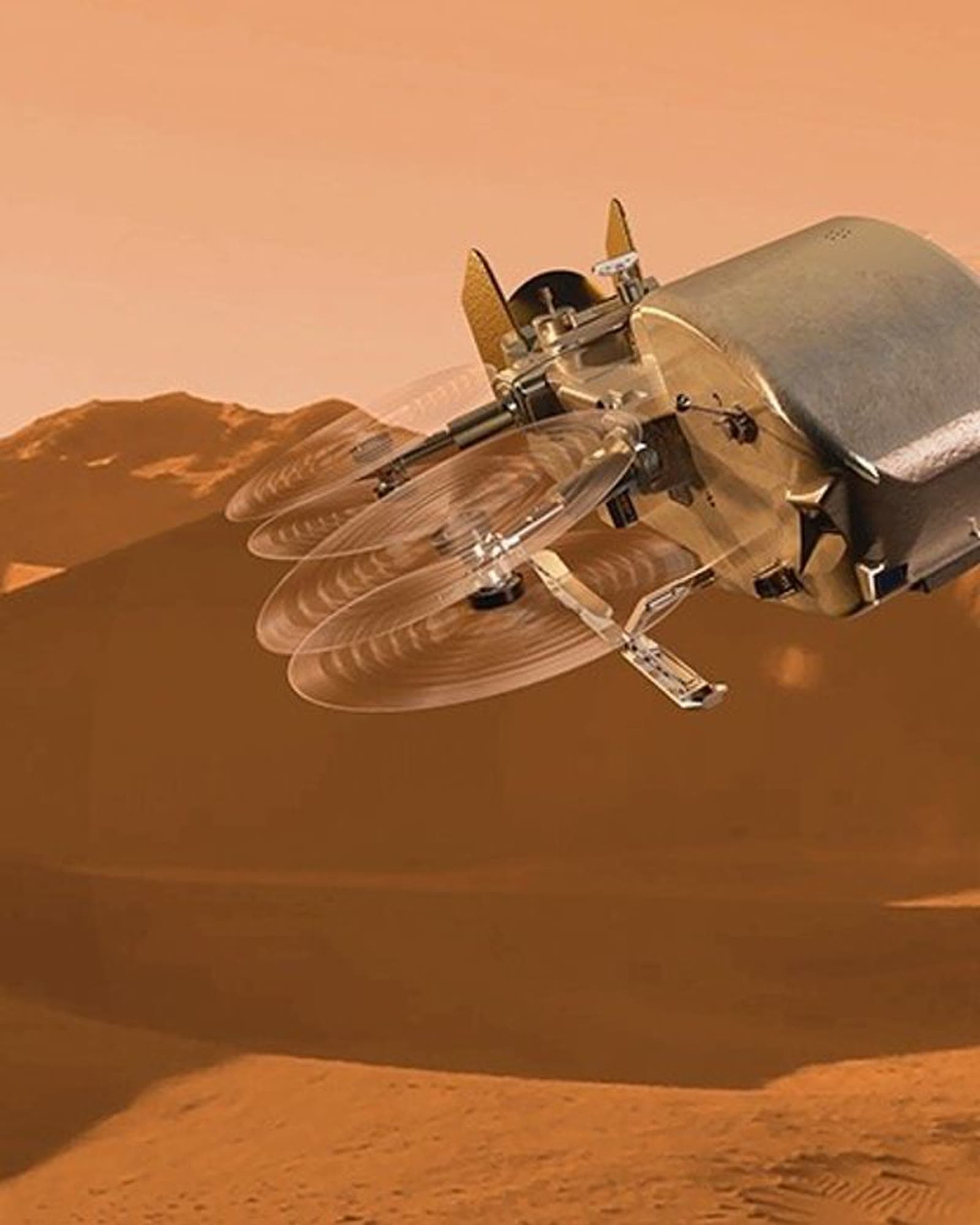
The vehicle is the mission architecture: a rotorcraft lander that can fly to new sites, stop, sample, recharge, and send data home. Titan's atmosphere makes that mobility plausible; Saturn's distance makes every autonomous decision matter.
The place matters just as much. Dragonfly starts in organic dunes and later works toward Selk Crater, where impact history may have mixed water ice and organic material in ways that help scientists test prebiotic chemistry.
The measurements will stay grounded in materials and environments: surface composition, atmospheric products, geologic context, and the chemical steps that can precede biology without proving biology is present.
Dragonfly rotorcraft lander
Flight article path: NASA lists Dragonfly as no earlier than July 2028 with late-2034 Titan arrival.
Titan's thick atmosphere and low gravity make short powered hops a practical science strategy instead of a visual gimmick.
Titan dunes and Selk Crater science sites
Landing geography: Dunes and Selk Crater give the mission its first public science terrain.
The site story matters because dunes, impact material, and possible past liquid-water interaction create different chemistry targets.
nuclear-powered flight operations
Power model: A radioisotope power system gives Dragonfly endurance through Titan's dim sunlight and cold environment.
The MMRTG converts plutonium-238 decay heat into electricity and warmth, then supports battery recharging between flights.
entry, descent, landing, and autonomy
Arrival risk: Entry, descent, landing, autonomy, and thermal protection are the gates before powered Titan flight.
Dragonfly has to survive arrival, orient itself, choose safe work, and communicate across Saturn-system distances.
prebiotic chemistry and habitability investigations
Science claim: Dragonfly studies prebiotic chemistry and habitability context, not direct life detection.
The chemistry result should connect methane-cycle organics, tholins, dunes, and possible water-organic mixing without becoming a life-detection headline.
What the image shows
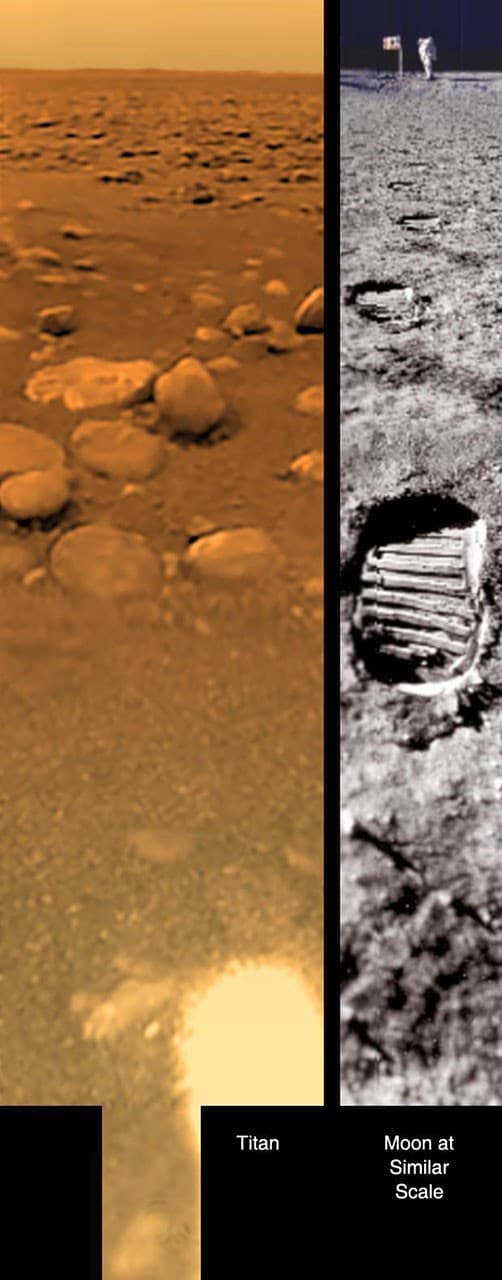
Titan is why Dragonfly can fly.
The Titan environment is not background scenery. Its thick haze, low gravity, cold surface chemistry, dunes, and methane cycle are the reason a flying laboratory can ask questions a rover or fixed lander could not.
Already real
NASA has selected the mission and launch service.
The mission has a destination, a vehicle concept, launch-service selection, and integration work. That makes Dragonfly more concrete than a far-future idea, even though the hardest work still waits for launch, cruise, landing, and Titan flight.
NASA's current public posture puts Dragonfly in integration and testing, with launch no earlier than July 2028 and arrival in late 2034. The mission is therefore proven as a selected and integrated flight project, but not yet as a Titan surface operation.
NASA has selected Dragonfly, assigned Falcon Heavy launch services, and moved the rotorcraft into integration and testing work.
Titan is scientifically distinct
dense atmosphere, organic chemistry, dunes, possible subsurface ocean context, and surface liquids make it unlike Mars or the Moon.
The mission concept is not life detection
it studies chemistry and environments that help scientists understand life's ingredients.
Still to prove
Titan flight still has to survive the real mission chain.
The hard problem is turning Titan's helpful atmosphere into dependable operations. Dragonfly still has to survive the cruise, thermal environment, entry, descent, landing, rotorcraft deployment, autonomous navigation, sampling, communications, and repeated surface work.
Power is part of that risk. Dragonfly's MMRTG converts heat from plutonium-238 decay into electricity and waste heat, supporting survival and battery recharging in Titan's dim sunlight. The spacecraft still has to manage when to fly, when to recharge, when to sample, and when to wait for a communication window.
The science risk is interpretation. Organic chemistry, possible water-rock interaction, and habitability context can be profound without becoming a claim that Dragonfly found life.
- 01Can Dragonfly keep thermal, rotorcraft, power, and integration work on track for the no-earlier-than July 2028 window?
- 02Can entry, descent, landing, and autonomous powered flight work after a long cruise to the Saturn system?
- 03Which findings clarify Titan's prebiotic chemistry without overstating what the mission can prove?
Worth watching
Watch the path from integration to Titan operations.
Useful updates will be about hardware integration, launch readiness, mission reviews, Titan arrival planning, and prebiotic chemistry results that are careful about what they do and do not prove.
A launch date, mission review, test result, or entry/descent/landing update matters because it moves Dragonfly toward the point where powered flight, sampling, and chemistry work can happen on Titan.