
 Your Guide to Space
Company profile
ULA is the mission-assurance bet behind Vulcan.
Vulcan is not trying to win the reuse spectacle. It is trying to replace Atlas and Delta heritage with a certified U.S. rocket for high-value national-security, civil, science, and commercial missions.
Read ULA through certification, orbital precision, cadence, and anomaly discipline. The company matters most when a payload is too valuable for thin proof or vague schedule confidence.
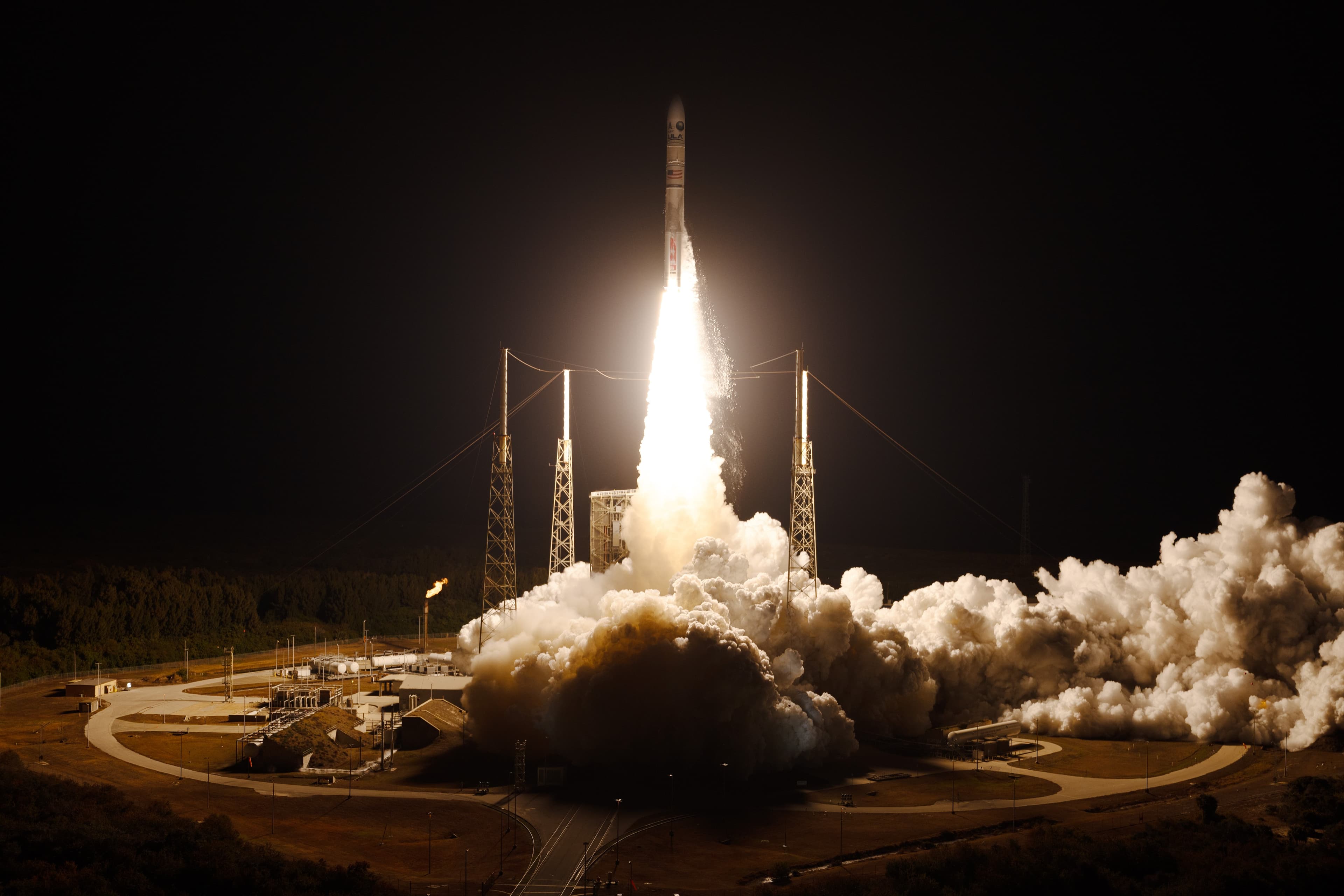
Vulcan has cleared certification and has flown consequential national-security work, including a direct geosynchronous delivery profile.
The next evidence is repeat flight, solid-rocket-motor corrective action, BE-4 supply, Centaur V consistency, and customer schedule recovery.
ULA matters when national-security, science, civil, and Kuiper-scale commercial missions need another modern U.S. launch path.
The quick read
United Launch Alliance: the quick read.
A few fast facts to get oriented before the deeper story on what it builds, what still has to work, and where it is headed.
High-reliability launch services for national security, civil, science, and commercial missions.
Where the work happens
Watch Vulcan cadence, solid-rocket-motor corrective action, Centaur V performance, BE-4 supply, Kuiper demand, and NSSL missions.
Recent developments
Latest on United Launch Alliance
Atlas V successfully launched 29 Amazon Leo satellites on LA-08
United Launch Alliance’s Atlas V 551 launched Amazon Leo (LA-08) from Space Launch Complex 41 at Cape Canaveral on 2026-07-02, with launch status listed as successful. The mission carried 29 broadband satellites to low Earth orbit, and ULA posted a launch-success update after liftoff.
Why it matters
What changes when mission assurance has a second modern path?
ULA matters because not every important mission is optimized for the cheapest kilogram to orbit. National-security spacecraft, high-value science, and deep-space probes often need strict integration, unusual orbits, and a provider that runs a launch campaign with discipline.
It is best understood as a mission-assurance company in transition. Atlas and Delta built the reliability reputation; Vulcan has to carry it forward with U.S.-built BE-4 engines, the high-energy Centaur V upper stage, and Space Force certification.
Active programs
ULA is a launch provider built around integration.
Vulcan Centaur is the key program, replacing Atlas and Delta with a modular booster, BE-4 engines, and Centaur V for high-energy missions. Centaur V is the real differentiator — the reason ULA can promise direct-to-orbit precision for the hardest trajectories.
Project Kuiper launches and pad upgrades are the cadence lane, while the wind-down of the remaining Atlas V flights bridges the old era into the new.
Current status
Certified, but still building the Vulcan record.
Vulcan has cleared certification for National Security Space Launch and flown consequential missions, including USSF-87 delivering a national-security spacecraft. That is the credential ULA needs.
But the record is not spotless yet: a disclosed solid-rocket-motor anomaly requires corrective action before ULA can inherit the full Atlas and Delta trust level. Certified and dependable are not quite the same thing.
Watch points
Look for evidence that reliability becomes cadence.
Watch the anomaly close and customers accept the return to flight. Watch the cadence of Space Force missions on Vulcan, and BE-4 and Centaur V performance together.
Watch Amazon's Kuiper demand and the pad upgrades that support a higher tempo, and watch the Atlas-to-Vulcan handoff stay clean enough that customers read ULA as continuity, not a risky reset.
On the launch calendar
| Mission | Status | Why it matters |
|---|---|---|
| NROL limited-information Vulcan mission | limited public information | The payload purpose is not public, so the responsible story is launch execution, disclosed customer context, and any official post-launch status. |
How it got here
Vulcan completed certification flights and received Space Force certification for National Security Space Launch missions.
USSF-87 showed certified Vulcan direct-to-GEO service while creating a solid-rocket-motor anomaly watch before the next mission.
Vulcan replaces Atlas and Delta heritage with a U.S.-built BE-4 booster engine path.
Centaur V is the core ULA differentiator for high-energy and complex orbital insertions.
Project Kuiper and national-security demand turn Vulcan from a certification story into a cadence and production story.
Keep exploring
How Rocket Launches Work
How Rocket Launches Work: A countdown-to-orbit guide that explains weather, fueling, max Q, staging, fairings, orbit insertion, payload deployment, and scrub logic.
Reusable Rockets
Why Reusable Rockets Matter: A guide to booster reuse, ship reuse, refurbishment, launch cadence, cost evidence, and why landing is only one part of reusability.
Who Regulates Spaceflight
Who Regulates Spaceflight: A guide to launch licensing, range safety, spectrum, remote sensing, exports, reentry, planetary protection, and international coordination.
Robotic Exploration
Robotic Exploration: A guide to probes, landers, rovers, sample return, outer-planet missions, and why robots often go first.
The New Space Age
The New Space Age: A plain-English overview of why the current era feels different: reusable launch, private capital, national programs, constellations, and lunar infrastructure.
Next steps
Keep the roadmap in view
Get major space updates, set launch reminder interest, or keep exploring the Roadmap that turns space progress into a readable system.