
 Your Guide to Space
Company profile
Vast is racing to make private stations tangible.
Haven Demo gives Vast real flight evidence. Haven-1 is the harder test: a crewed free-flyer that must clear integration, life support, launch, docking, customer demand, and NASA transition scrutiny.
Separate a flown testbed from a crewed station. Haven Demo reduces some technical uncertainty; Haven-1 still has to become a safe, useful place for people and payloads.
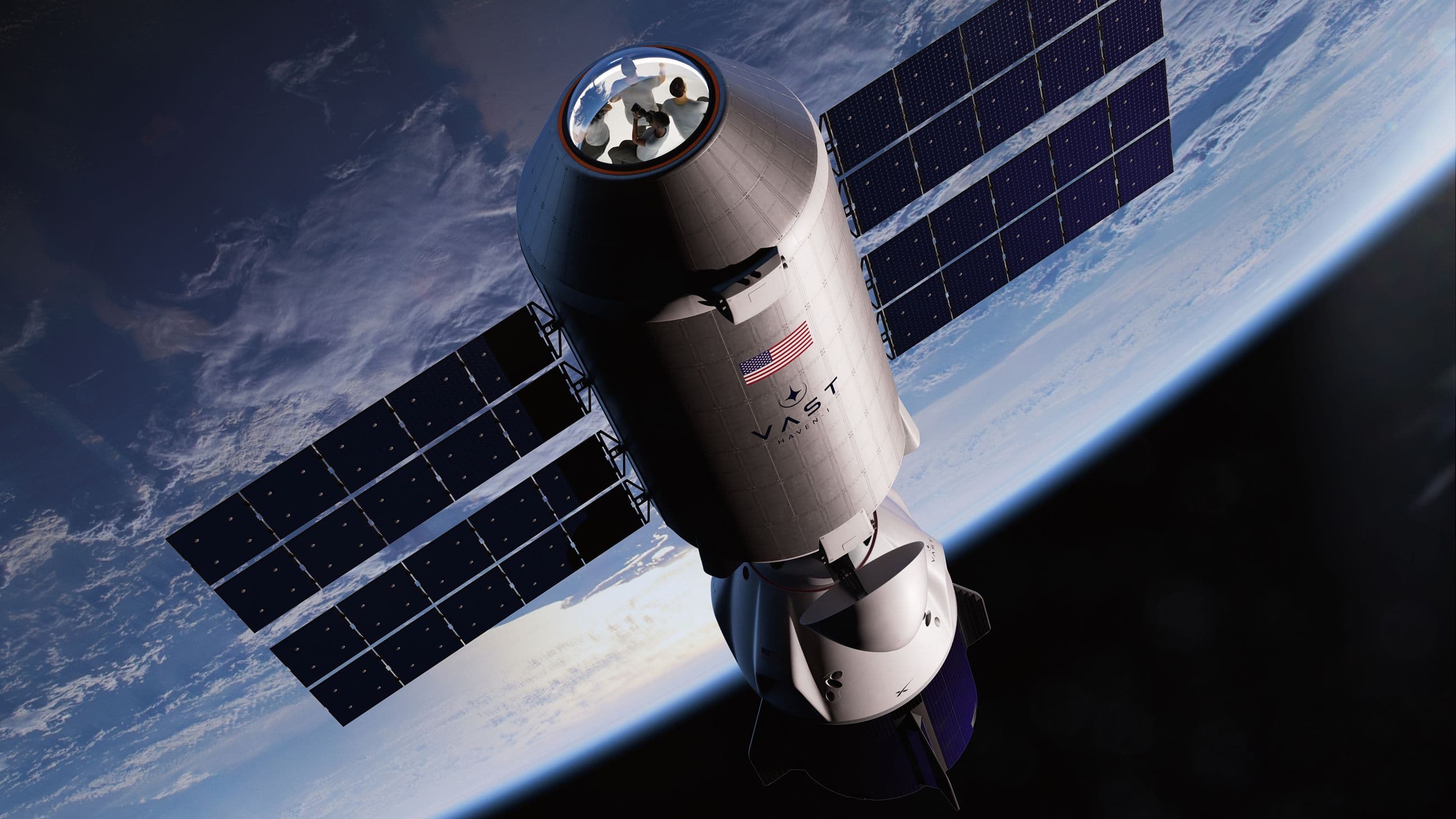
Vast has operated its own spacecraft in orbit, tested core systems, stayed power positive, and completed a controlled deorbit.
Haven-1 still needs integration, environmental testing, launch, commissioning, life-support proof, Dragon compatibility, and crewed mission acceptance.
Vast matters if a small early station can turn flight demos into post-ISS services before larger station architectures arrive.
Why it matters
What changes if a first private station arrives early?
Vast matters because it is taking a different route into the post-ISS market: instead of a large multi-module station, it wants to fly a smaller commercial free-flyer quickly, learn, and compete for the next generation of orbital destinations.
It is no longer only a concept. Haven Demo launched in 2025, operated on orbit, returned early data, and made a controlled deorbit in 2026 — flight evidence for power, avionics, communications, and mission operations before the crewed station flies.
Active programs
Vast is turning demos, hardware, and transport into one test.
Haven Demo gave Vast real flight experience with station-adjacent systems. Haven-1 is the near-term station — a single-module free-flyer for short crew visits, research, and manufacturing that will test whether private stations can move faster than government programs.
SpaceX's Falcon 9 and Crew Dragon provide the first access path, NASA collaboration and a selected private astronaut mission connect it to customers, and Haven-2 and Vast Satellite point beyond the first free-flyer.
Current status
Flight evidence is real; crewed station service is not yet.
Vast has one flown precursor and one much harder station in integration. Haven Demo was an uncrewed testbed that launched in November 2025 and deorbited in February 2026 after completing dozens of objectives.
Haven-1 is still unfinished: Vast says it has entered integration, will undergo environmental testing at NASA's Neil Armstrong Test Facility, and targets Q1 2027 launch readiness on a contracted Falcon 9. Meaningful steps — but it still has to launch, host a Dragon, support life, and carry a crew.
Watch points
How Haven Demo flight data is shaping Haven-1.
Watch Haven-1 integration for risk-reducing milestones — completed structure, life-support qualification, shielding, and environmental testing at NASA Armstrong. Watch the SpaceX-linked steps: Falcon 9 assignment, Dragon integration, docking evidence.
Watch NASA's commercial-LEO procurement and the selected private astronaut mission, and watch customer quality — named research partners and signed commitments matter more than talk of a future orbital economy.
On the launch calendar
| Mission | Status | Why it matters |
|---|---|---|
| Commercial station pathfinder mission | concept-to-hardware watch | Commercial station pathfinders reveal whether the post-ISS market can move from renderings into tested hardware. |
How it got here
Haven Demo launched in November 2025, operated on orbit, and completed a controlled deorbit in February 2026.
Vast says Haven Demo completed 49 test objectives and remained power positive through its mission.
Haven-1 advanced into integration, with Vast targeting Q1 2027 readiness for a Falcon 9 launch after environmental testing.
NASA selected Vast for a sixth private astronaut mission to the ISS, targeted no earlier than summer 2027.
Keep exploring
How Rocket Launches Work
How Rocket Launches Work: A countdown-to-orbit guide that explains weather, fueling, max Q, staging, fairings, orbit insertion, payload deployment, and scrub logic.
Reusable Rockets
Why Reusable Rockets Matter: A guide to booster reuse, ship reuse, refurbishment, launch cadence, cost evidence, and why landing is only one part of reusability.
Commercial Space Stations
Commercial Space Stations: A guide to why post-ISS stations are being built, who is building them, who might pay, and what has to work before they become real infrastructure.
The New Space Age
The New Space Age: A plain-English overview of why the current era feels different: reusable launch, private capital, national programs, constellations, and lunar infrastructure.
Start Here
How to Follow the New Space Age: The space industry is moving faster than it has in decades. Here's what's changing, why it matters, and how to keep up without getting lost.
Next steps
Keep the roadmap in view
Get major space updates, set launch reminder interest, or keep exploring the Roadmap that turns space progress into a readable system.