
 Your Guide to Space
Company profile
Axiom is the bridge between ISS access and private stations.
Axiom already sells and operates private astronaut missions to the ISS. The harder promise is turning that access into a privately owned station, NASA service contracts, and lunar spacesuits that pass human-rating scrutiny.
Separate access from infrastructure. Ax missions prove operating experience on the ISS; Axiom Station and AxEMU still need launch, certification, customer demand, and NASA acceptance.
Axiom has flown private and sovereign crews to the ISS, building experience in crew integration, mission support, and microgravity research operations.
The hard gates are station module launch and free-flight service, NASA certification, AxEMU acceptance, recurring customers, and schedule control.
Axiom matters if it turns ISS-era experience into a destination NASA, national astronauts, researchers, and companies can buy from.
Why it matters
What changes when NASA buys a destination instead of owning it?
Axiom matters because keeping people living and working in orbit after the ISS retires is not just a NASA budget question — someone has to turn ISS experience into privately owned infrastructure NASA can buy from.
It is one of the clearest bridges between those eras: it already runs private astronaut missions using SpaceX's Dragon, and its bigger bet, Axiom Station, starts attached to the ISS before becoming a free-flying destination. It even reaches the Moon through AxEMU, the Artemis spacesuit NASA selected.
Active programs
Axiom spans crew access, station hardware, and suits.
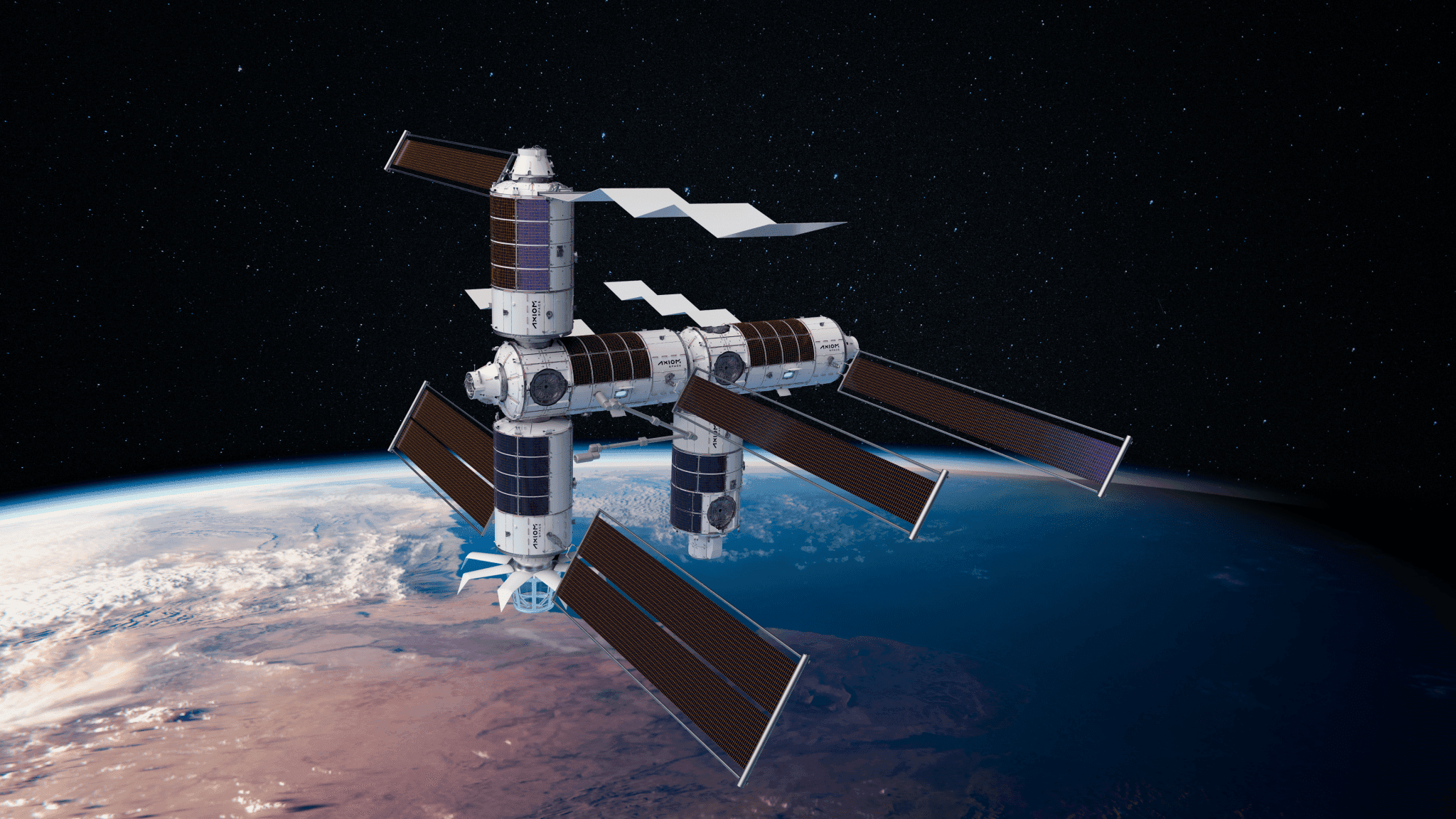
Axiom Station is the key bet — a sequence of modules meant to become an independent commercial destination. The Ax private astronaut missions are the operating proof, showing Axiom can sell, train, and support crews.
AxEMU is the lunar and spacewalking suit lane, and research, manufacturing, and orbital-data services are the demand lane the business ultimately needs.
Current status
Operational experience today, unproven station service tomorrow.
The operating layer is real: Axiom's Ax missions have flown private and sovereign astronauts to the ISS, including Ax-4 in 2025 with an 18-day mission — human-spaceflight experience before its own station even exists.
The infrastructure layer is still developmental. NASA and Axiom reordered the assembly sequence to put the power and thermal module first for an earlier free-flight path, but no Axiom module is on orbit yet. And the spacesuit, while advancing through testing, is flagged by NASA's inspector general as behind schedule.
Watch points
Look for proof that station plans become services.
Watch Axiom Station hardware move through the sequence — pressure-vessel testing, module integration in Houston, launch, ISS berthing, free-flight separation, and NASA certification. Watch NASA's commercial-LEO procurement for whether the station becomes a funded service option.
Watch the Ax missions for demand quality — sovereign crews, research volume, repeat customers — and watch AxEMU reviews and delivery, where NASA acceptance decides whether the suit becomes an operational capability.
On the launch calendar
| Mission | Status | Why it matters |
|---|---|---|
| Commercial station pathfinder mission | concept-to-hardware watch | Commercial station pathfinders reveal whether the post-ISS market can move from renderings into tested hardware. |
How it got here
Axiom's private astronaut missions have already given the company operational ISS experience with SpaceX Dragon as the transport layer.
NASA and Axiom revised the station assembly order so the Payload Power Thermal Module can support an earlier free-flying station path.
Axiom's 2025 review reported pressure-vessel work, docking-adapter progress, and propulsion hot-fire evidence, but no station module is operating on orbit yet.
AxEMU makes Axiom a lunar-surface dependency as well as a station company, with NASA reviews and schedule risk still active.
Keep exploring
Why the Moon Matters
Why the Moon Matters: A guide to why lunar missions matter for technology, science, geopolitics, operations, resources, and Mars preparation.
Artemis Explained
Artemis Explained: A guide to SLS, Orion, Gateway, Human Landing System, spacesuits, surface logistics, and how the Artemis missions build on each other.
Commercial Space Stations
Commercial Space Stations: A guide to why post-ISS stations are being built, who is building them, who might pay, and what has to work before they become real infrastructure.
The New Space Age
The New Space Age: A plain-English overview of why the current era feels different: reusable launch, private capital, national programs, constellations, and lunar infrastructure.
Start Here
How to Follow the New Space Age: The space industry is moving faster than it has in decades. Here's what's changing, why it matters, and how to keep up without getting lost.
Next steps
Keep the roadmap in view
Get major space updates, set launch reminder interest, or keep exploring the Roadmap that turns space progress into a readable system.